
Anti-Ageing Skincare in Singapore: A Practical Guide to Preventing and Manageing Skin Ageing
Aeging is a natural part of life, and changes in the skin are expected over time. Fine lines may become more visible, skin can feel drier or less resilient, pigmentation may become more noticeable, and the face may gradually lose some firmness and elasticity.
However, not every visible sign of ageing is caused by chronological ageing alone. Sun exposure, lifestyle factors and repeated environmental stress can also contribute to premature skin ageing.
This is why effective anti-ageing skincare is less about finding one “miracle” product and more about following a consistent routine that protects the skin, supports its barrier and addresses specific concerns appropriately.
For people living in Singapore, daily sun protection deserves particular attention. According to Singapore’s National Environment Agency (NEA), maximum UV radiation levels typically occur between 11am and 3pm, and the UV Index can reach Very High or Extreme levels during this period on days with little cloud cover.
This guide explains what happens to ageing skin, which skincare steps matter most, which ingredients have evidence behind them, and when professional advice may be appropriate.
Medical note: This article provides general educational information and is not a diagnosis or substitute for medical advice. Individual skin concerns, medical conditions, medications and suitability for aesthetic treatments should be assessed by an appropriately qualified healthcare professional.
What Happens to Skin as We Age?
Skin ageing involves gradual changes in the epidermis, dermis and supporting structures of the skin.
As we get older, skin cell renewal slows and the skin may become thinner, drier and less resilient. Changes in collagen and elastin contribute to reduced firmness and elasticity, while changes in the skin’s structure can contribute to wrinkles and sagging. HealthHub, drawing on information from the National Skin Centre, notes that ageing skin may become thinner and drier, with reduced supporting structures and elasticity.
| Skin Change | What may happen | Why it matters |
| 细纹与皱纹 | Lines become more visible over time | Often associated with reduced skin elasticity and cumulative environmental exposure |
| 干燥 | Skin may retain less moisture | Can make the skin feel rough or tight |
| Loss of firmness | Skin may gradually become less resilient | Can contribute to changes in facial contour |
| Uneven pigmentation | Darker spots or uneven tone may become more noticeable | Cumulative UV exposure can contribute |
| Rough texture | Skin surface may feel less smooth | Slower renewal and dryness can contribute |
These changes do not happen at exactly the same age or rate for everyone. Genetics, cumulative sun exposure, lifestyle and individual skin characteristics all influence how skin changes over time
Chronological Ageing vs Photoageing
It is useful to distinguish between intrinsic ageing and photoageing.
Intrinsic ageing refers to the natural biological ageing process that occurs over time.
Photoageing is skin damage associated with chronic exposure to ultraviolet radiation. UV exposure is a major contributor to premature skin ageing and can contribute to wrinkles, pigmentation changes and loss of elasticity.
This distinction matters because some aspects of photoageing can be reduced through consistent sun protection.
In other words, anti-ageing skincare is not about stopping the ageing process. It is about helping protect the skin and manageing visible changes as they develop.
Why Sun Protection Is the Foundation of Anti-ageing Skincare in Singapore
If there is one step that should form the foundation of an anti-ageing routine, it is sun protection.
Singapore’s geographical location means UV exposure is relevant throughout the year. The NEA’s UV Index information identifies 11am to 3pm as the period when UV radiation is typically at its highest.
HealthHub also notes that excessive UV exposure can contribute to premature ageing, wrinkling, pigmentation and skin damage.
| Sun-protection habit | Practical approach |
| Sunscreen | Use broad-spectrum SPF 30+ |
| Reapplication | Reapply when appropriate, especially during prolonged outdoor exposure |
| Shade | Seek shade where practical |
| Clothing | Use protective clothing and a hat for extended outdoor exposure |
| Sunglasses | Wear UV-protective sunglasses |
The goal is not to avoid sunlight completely. It is to reduce excessive and cumulative UV exposure.
What Should a Skincare Routine for Ageing Skin Look Like?
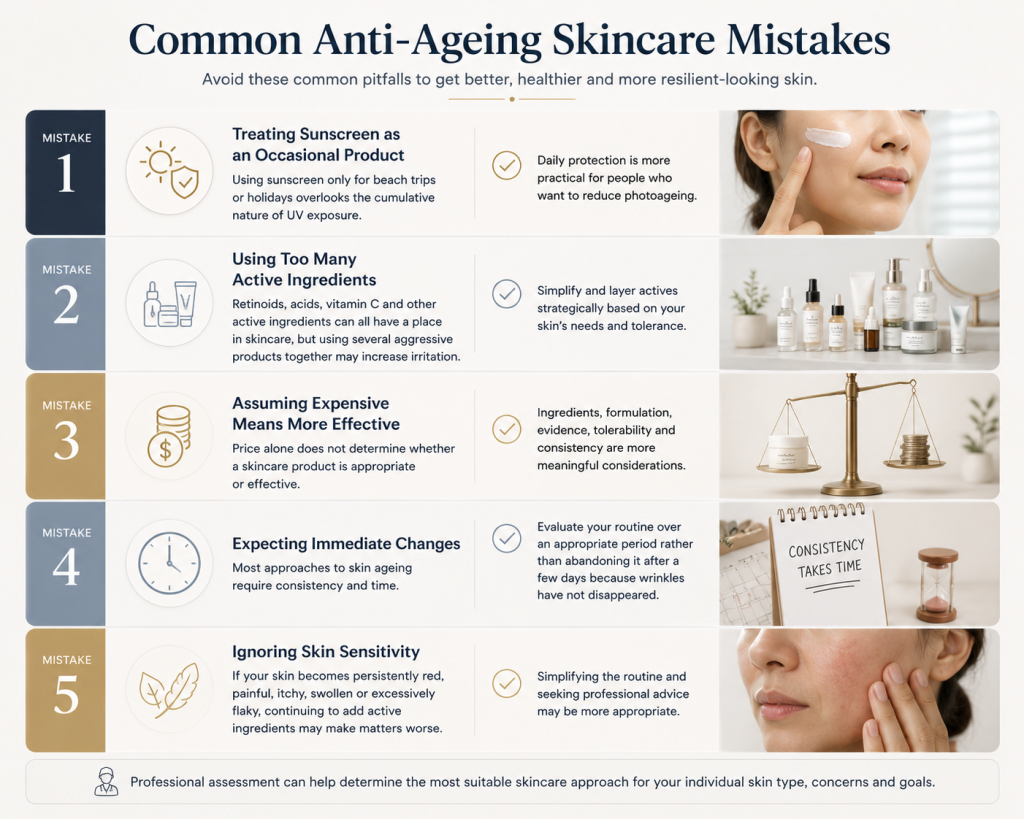
A complicated routine is not necessarily a better routine.
For many people, a consistent routine built around cleansing, moisturising, sun protection and carefully selected active ingredients are more practical than layering numerous products.
A routine does not need to contain every possible active ingredient. The appropriate combination depends on skin type, sensitivity and individual concerns.

Ingredients Commonly Used in Skincare for Ageing Skin
A good skincare routine does not need to contain every active ingredient available. Instead, different ingredients can serve different purposes, from protecting the skin against UV exposure and maintaining hydration to supporting the skin barrier, improving the appearance of uneven tone and addressing visible signs of photoageing. The right combination depends on your skin type, sensitivity and individual concerns.
The table below provides an overview of key ingredient categories commonly considered in an ageing-skin skincare routine and explains their general relevance.
| 主要成分 | Role in the Skincare Regime | Relevance to Ageing Skin |
| Niacinamide, Cordyceps Militaris Extract, Salicylic Acid, Lactobacillus/Pear Juice Ferment Filtrate | First-step essence designed to prepare the skin while supporting clarity, texture and overall skin condition | Helps support a smoother, more even-looking complexion and skin barrier |
| Niacinamide, Collagen & Procollagen Peptides, Beta-Glucan, Hydroxypropyl Tetrahydropyrantriol, Pichia Ferment Lysate Filtrate | Hydration-focused essence to support moisture balance, suppleness and skin texture | Particularly relevant to dryness, roughness and the appearance of reduced elasticity that may accompany ageing skin |
| Niacinamide, Tranexamic Acid, 3-O-Ethyl Ascorbic Acid, Hyaluronic Acid, Portulaca Oleracea Extract | Night-time care focused on hydration, tone and visible dullness or discoloration | Supports a more even-looking complexion and helps address visible concerns that can contribute to an aged-looking appearance |
| Niacinamide, Collagen & Procollagen Peptides, Beta-Glucan, Hydroxypropyl Tetrahydropyrantriol, Pichia Ferment Lysate Filtrate | Additional care focused on hydration, comfort and skin barrier support | Relevant to dry, rough or less resilient-feeling skin, helping maintain a smoother and more hydrated appearance |
DR HAACH takes a skin-quality approach to daily skincare through its Derma Cell Renewal Series, with formulations that place emphasis on hydration, barrier support, skin texture and more even-looking skin tone. Rather than relying on a single “anti-ageing” ingredient, the range combines different ingredients across the skincare regime to address several changes that can become more noticeable with age, such as dryness, dullness, uneven tone, rough texture and the appearance of reduced elasticity.
A Practical Anti-ageing Routine for Different Skin Concerns
A skincare routine for ageing skin should be tailored to individual skin type, sensitivity and concerns. Key priorities may include hydration, skin barrier support, even-looking skin tone and the management of visible changes in texture and firmness.
The following guide highlights some common concerns and the skincare priorities that may be considered for each.
| Common concern | General skincare priorities |
| Fine lines | Sun protection, moisturisation and appropriate retinoid/retinol use |
| 干燥 | Gentle cleansing and regular moisturisation |
| Uneven pigmentation | Sun protection and appropriately selected brightening ingredients |
| Rough texture | Hydration and controlled exfoliation |
| Loss of firmness | Sun protection, moisturisation and professional assessment where appropriate |
| Sensitive skin | Gentle products, moisturisation and fewer active ingredients |
These are general skincare considerations rather than treatment recommendations. Persistent, severe or changing skin concerns should be assessed by an appropriately qualified healthcare professional.
How to Prevent Premature Skin Ageing
Although natural ageing cannot be stopped, several habits can help reduce avoidable skin stress.
1. Protect Your Skin From Excessive UV Exposure
This is one of the most important preventive measures.
Use sunscreen consistently and combine it with shade, hats and protective clothing when appropriate.
2. Avoid Smoking
Smoking is associated with premature skin ageing and can contribute to changes in skin appearance.
If you smoke, quitting provides health benefits far beyond skincare.
3. Maintain a Balanced Diet
Skin health is influenced by overall nutrition.
A balanced diet containing vegetables, fruit, whole grains, protein sources and healthy fats is more meaningful than relying on a single “beauty food” or supplement.
HealthHub recommends a balanced diet as part of healthy ageing and highlights the importance of nutrient-rich foods.
4. Prioritise Sleep and Physical Activity
Healthy ageing is broader than skincare alone.
Regular physical activity, adequate sleep and healthy lifestyle habits support general health, which is also relevant to maintaining skin health over time.
5. Avoid Constantly Changing Products
Switching between multiple active ingredients every few days makes it difficult to determine what is helping or irritating the skin.
A consistent routine gives you a better opportunity to assess how your skin responds.
What About Professional Anti-Ageing Treatments?
Skincare is only one part of managing visible signs of ageing.
The appropriate option depends on the specific concern, skin condition, medical history and expected outcome.
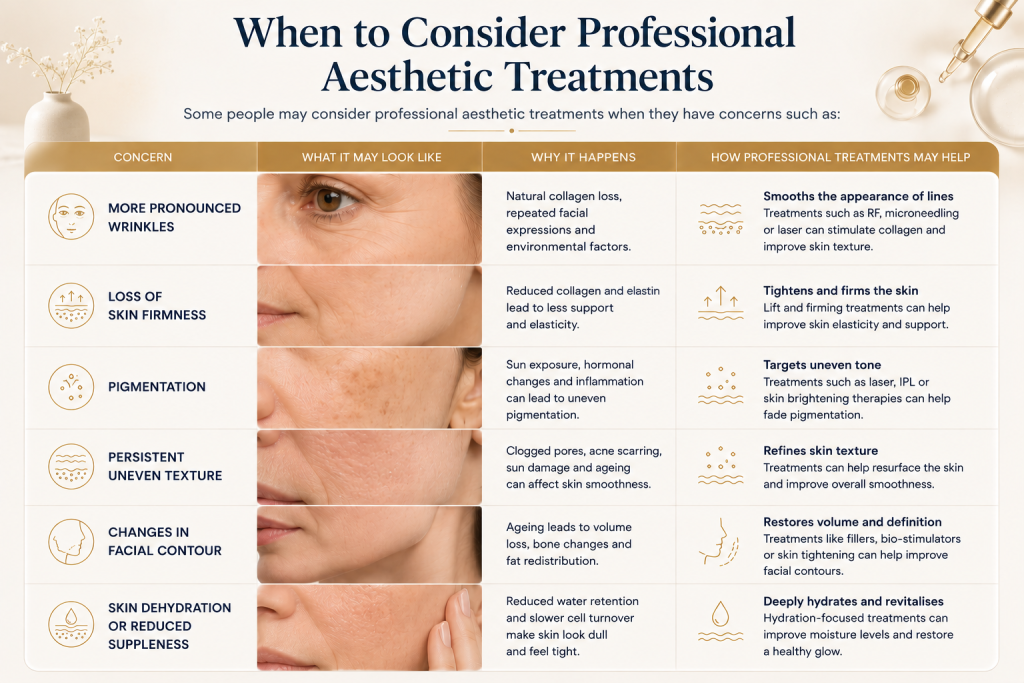
Professional aesthetic treatments are one option for people who want to take a more targeted approach to changes associated with skin ageing. At Dr HAACH, treatment options are considered based on the individual’s skin condition, concerns and suitability, with different technologies working through different mechanisms to support the appearance and health of ageing skin.
| Skin-ageing concern | Professional treatment options | What they may support |
| Loss of firmness | HIFU, RF-based treatments | May improve the appearance of skin laxity |
| Uneven skin appearance | Selected laser treatments, chemical peels | More even-looking tone and texture |
| Dry or dehydrated-looking skin | Skin boosters | Skin hydration and a more supple appearance |
| Rough or uneven texture | Chemical peels, selected laser treatments | Smoother-looking skin texture |
| Fine lines and visible signs of ageing | Treatment selection depends on the individual | Overall improvement in the appearance of ageing skin |
Professional treatments should not be viewed as replacements for daily skincare. Sun protection, appropriate moisturisation and a sensible home routine remain important parts of ongoing skin care.
A consultation is particularly useful when you are unsure whether a visible change is simply an age-related cosmetic concern or something that requires medical assessment.
When Should You See a Doctor About a Skin Change?
Not every new mark or change in the skin is simply a sign of ageing.
HealthHub advises seeking medical attention for concerning changes such as enlarging skin growths or a sore that does not heal.
Consider seeing a doctor or dermatologist if you notice:
- A new or rapidly changing mole or growth
- A sore that does not heal
- Persistent unexplained bleeding or crusting
- Significant inflammation
- A new rash that does not improve
- Sudden or unusual pigmentation changes
- Persistent irritation despite stopping skincare products
This is one reason why “anti-ageing” should not automatically mean treating every skin change with a cosmetic product.
How to Choose Anti Ageing Skincare in Singapore
When comparing anti ageing skincare Singapore options, look beyond the marketing language on the front of the packageing.
Check the Ingredients
Look for ingredients that are appropriate for your particular concern rather than choosing products simply because they contain the phrase “anti-ageing”.
Introduce One Active at a Time
Adding several new active ingredients simultaneously can make irritation more likely and makes it difficult to identify the cause if your skin reacts.
Consider Your Skin’s Tolerance
An ingredient with good evidence is not necessarily suitable for everyone.
For example, retinoids can be effective but may cause dryness and irritation. Starting gradually can improve tolerability.
Be Careful With “Miracle” Claims
Singapore’s Health Sciences Authority advises consumers to be cautious of exaggerated cosmetic claims and products promising miraculous results. Cosmetic products are not intended to treat or prevent medical conditions, and claims for cosmetic products must be appropriately substantiated.
This is particularly important when buying skincare online from unfamiliar overseas sellers.
HSA has also reported cases involving anti-ageing and whitening products containing prohibited or potent ingredients.
预约咨询
Frequently Asked Questions About Anti-Ageing Skincare
Yes. Daily sun protection is an important part of an anti-ageing skincare routine because cumulative UV exposure is a major contributor to photoageing. A broad-spectrum sunscreen with SPF 30 or higher is a practical starting point, together with shade and protective clothing when appropriate.
Anti-ageing skincare can be considered when concerns such as dryness, uneven tone, fine lines or changes in skin texture become relevant to you. Foundational care such as daily sun protection, gentle cleansing and moisturisation can be incorporated as part of a consistent skincare routine, while targeted active ingredients should be selected according to individual skin needs and tolerance.
Retinol may help improve the appearance of fine lines, uneven tone and skin texture. Retinoids as a broader class have substantial evidence for photoageing, although stronger prescription retinoids such as tretinoin may cause irritation and should be used appropriately.
Skincare cannot stop natural biological ageing. However, consistent sun protection and appropriate skincare can help reduce avoidable environmental damage and manage some visible signs of ageing.
A skincare routine for mature skin should be tailored to individual skin type, sensitivity and concerns. A practical routine may include gentle cleansing, regular moisturisation, daily sun protection and appropriately selected active ingredients, depending on the individual’s needs and skin tolerance.
Not necessarily. Some people may tolerate retinol regularly, while others need to begin less frequently. Starting gradually and moisturising can help reduce irritation.
They can sometimes be incorporated into the same overall skincare routine, but using multiple active ingredients simultaneously may increase irritation. If you are new to both, introducing them separately and gradually is a more cautious approach.
Moisturiser cannot reverse structural skin ageing, but improving skin hydration can temporarily make some fine lines appear less noticeable and can help maintain the skin barrier.
Professional treatment may be worth discussing when concerns such as pronounced wrinkles, skin laxity, pigmentation or persistent texture changes are not adequately addressed by your skincare routine. A qualified aesthetic doctor can assess whether a procedure is appropriate and explain its potential benefits, limitations and risks.
Cosmetic products in Singapore are regulated under the Health Products Act and ASEAN Cosmetic Directive framework, but cosmetic product notification should not be interpreted as HSA approval or endorsement of a product’s safety or effectiveness.
Conclusion: Effective Anti-Ageing Skincare Is About Consistency
Good anti-ageing skincare does not need to be complicated.
For most people, the fundamentals are straightforward: protect the skin from excessive UV exposure, cleanse gently, maintain hydration, choose evidence-informed active ingredients and avoid unnecessarily irritating the skin.
For ageing skin, consistency is usually more valuable than constantly searching for the newest product.
If you are dealing with more pronounced wrinkles, pigmentation, loss of firmness or other persistent concerns, professional assessment can help determine whether skincare alone is appropriate or whether an aesthetic treatment may be considered.
At Dr HAACH, aesthetic doctors provide personalised assessment for concerns including wrinkles, pigmentation, sun damage, skin laxity and other signs associated with skin ageing.
Ultimately, healthy-looking skin is not about trying to stop ageing. It is about protecting your skin, understanding how it changes and choosing appropriate care at each stage.