


引言
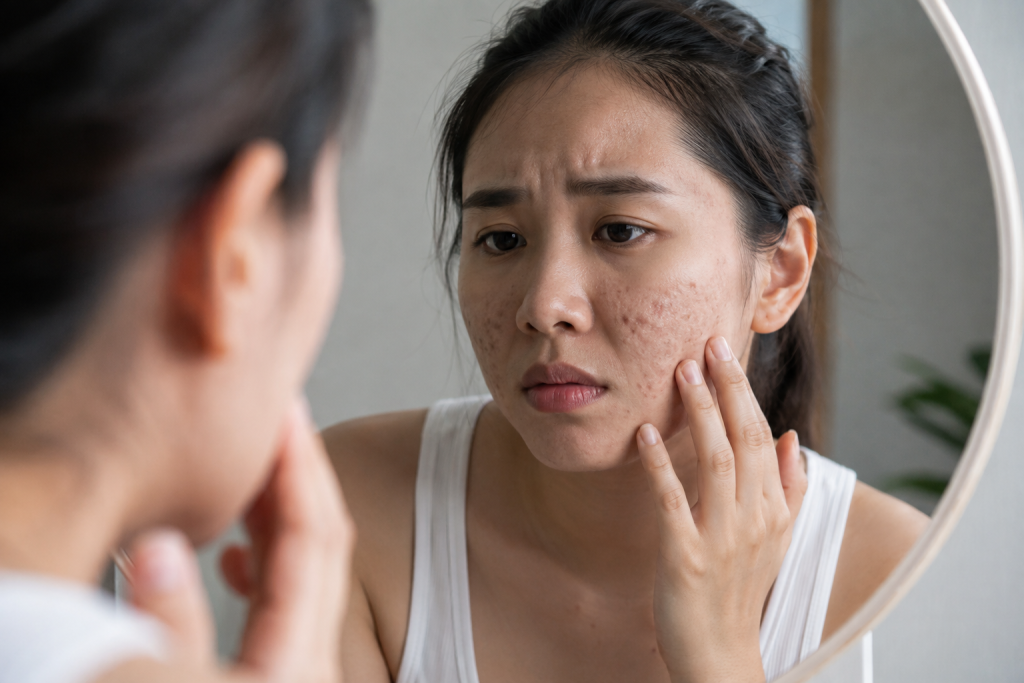
Acne can clear, but the changes left behind may remain for much longer. Some people develop flat brown or dark marks, while others are left with persistent redness or changes in skin texture, including depressed or raised scars.
These changes are not all the same. Acne scar treatment depends on what type of skin change is present, its characteristics, the individual’s skin and whether active acne is still occurring.
If you are researching acne scar treatment in Singapore, understanding the difference between acne marks and structural scars can help you understand why different treatment approaches may be considered.
This guide explains the types of acne scars, how they develop, the treatment approaches that may be considered, and why a medical assessment can be useful before deciding on a procedure.
Medical information note: This article provides general educational information and is not a diagnosis or personalised treatment recommendation. Individual suitability for any medical or aesthetic procedure should be determined by a qualified medical practitioner.
Acne Marks vs Acne Scars: What Is the Difference?
The terms “acne marks” and “acne scars” are often used interchangeably, but they can refer to different changes in the skin.
Understanding this distinction is an important first step because a flat change in skin colour is managed differently from a structural depression or raised scar.
Post-acne pigmentation
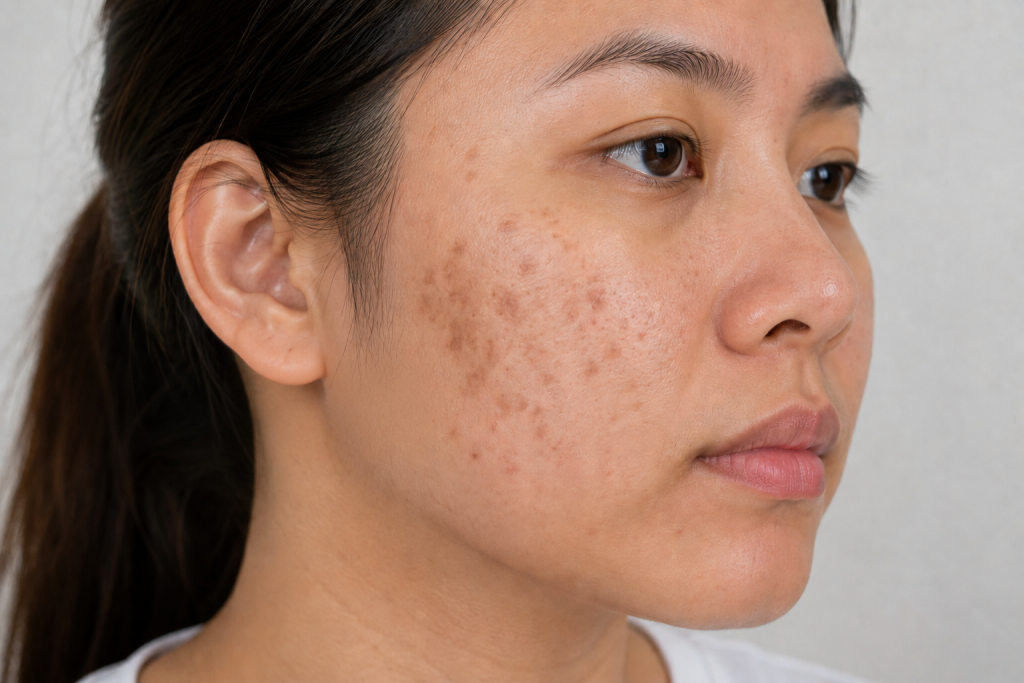
A flat brown or dark area left after an acne lesion may be post-inflammatory hyperpigmentation (PIH).
Unlike a structural acne scar, pigmentation is primarily a change in skin colour rather than a depression or raised area.
HealthHub Singapore notes that hyperpigmentation can occur after acne and that mild pigmentation may improve over several months. Sun exposure can also make dark marks more noticeable.
Red or pink acne marks
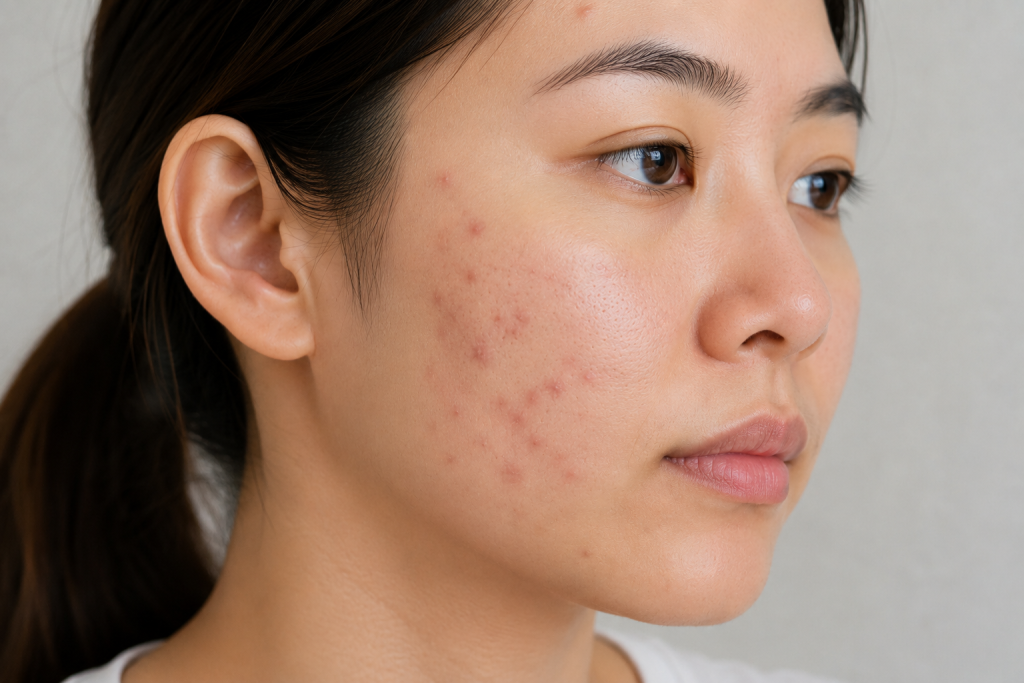
Some people notice persistent red or pink areas after an acne lesion has settled.
These colour changes are different from a structural scar because the main visible change may be redness rather than a permanent alteration in the skin’s contour.
If pigmentation, redness and textural changes occur together, a medical assessment may help distinguish between them.
Structural acne scars
Structural acne scars involve a change in the contour or texture of the skin.
They are broadly classified into:
- Atrophic acne scars — depressed or sunken scars.
- Hypertrophic scars — raised scar tissue that generally remains within the original area of injury.
- Keloid scars — raised scar tissue that can extend beyond the original area of injury.
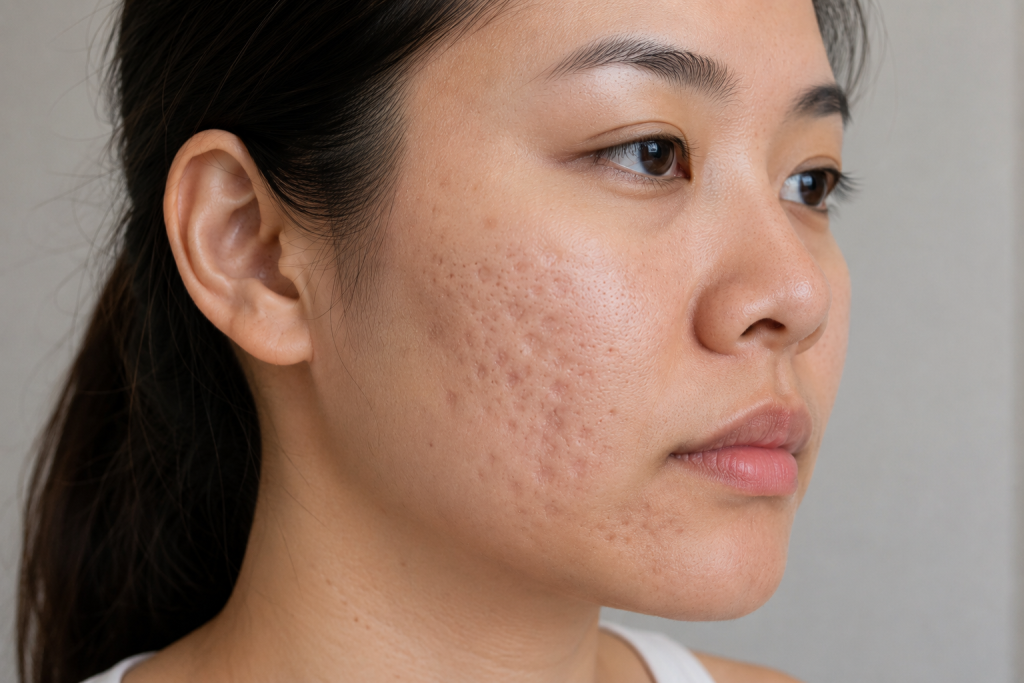
This distinction is important because acne scar treatment is not a single procedure that works in the same way for every scar.
If you are unsure whether you have pigmentation, redness or a structural scar, a medical assessment can help distinguish between them.
What Causes Acne Scars?
Acne scarring is associated with inflammation and damage occurring deeper within the skin.
During the healing process, the body produces collagen to repair damaged tissue. If the healing process results in too little or too much collagen being produced, the skin may heal with a depression or raised area rather than returning completely to its previous appearance. More inflammatory forms of acne, including pustules, nodules and cysts, are associated with a higher risk of scarring due to how it affects the deeper layers of skin.
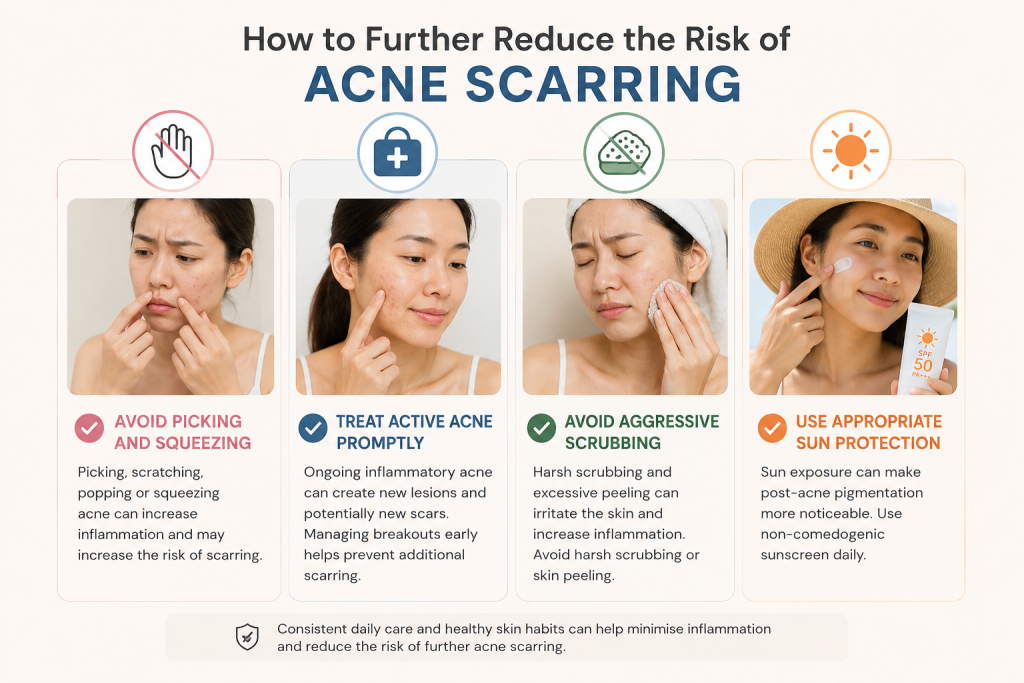
Picking, squeezing or popping acne can further disrupt the healing process and increase inflammation and the likelihood of scarring. Prompt management of active acne is therefore an important part of reducing the risk of new scars.
This also explains why treating acne scars is not always the first step. If active inflammatory acne is still occurring, managing the acne itself may need to form part of the overall plan before focusing primarily on established scarring.
痤疮疤痕的类型
Knowing the type of scar you have can help you understand why different acne scar treatment options may be considered.
1. Atrophic Acne Scars
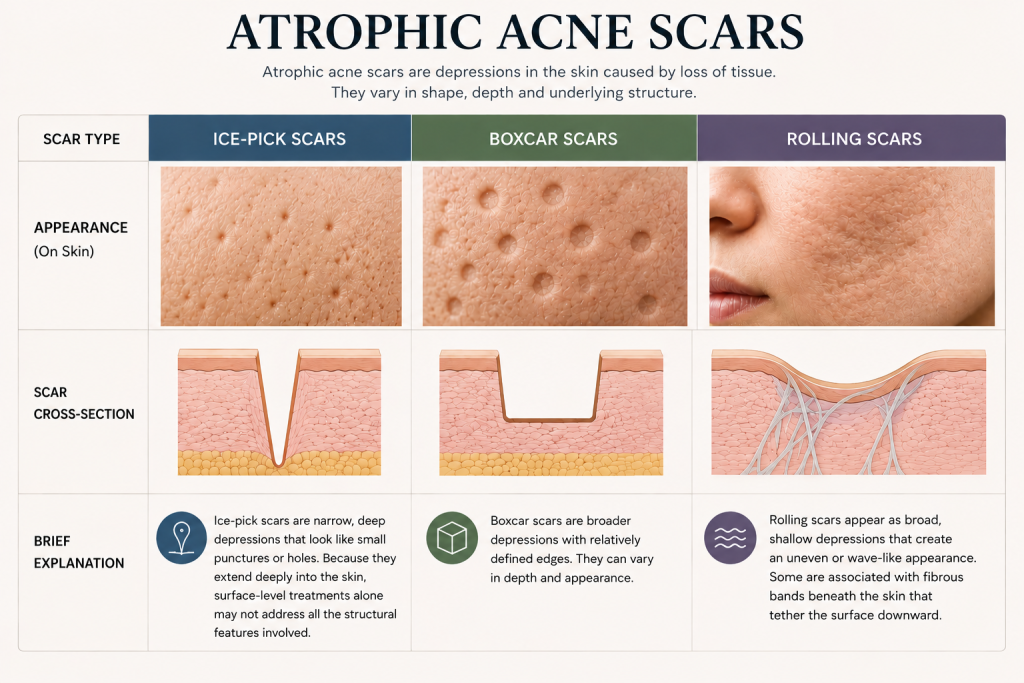
Atrophic acne scars are depressed scars that form when there is a loss of tissue during the healing of acne. They can differ considerably in their shape, depth and structure. The three main types — ice-pick, boxcar and rolling scars — are illustrated below to help you understand how they may appear on the skin.
2. Hypertrophic Acne Scars
Unlike atrophic scars, hypertrophic scars are raised.
They develop when excess scar tissue forms during the healing process. They may occur following inflammatory acne and can be more noticeable on areas such as the chest, shoulders and back.
Because hypertrophic scars are raised rather than depressed, treatment approaches used for pitted acne scars may not be appropriate.
A doctor may assess the scar’s size, thickness, location and behaviour before determining which scar-management approach may be suitable.
3. Keloid Acne Scars
Keloids are also raised scars, but they differ from hypertrophic scars because they can extend beyond the boundaries of the original injury.
They may become firm, itchy or uncomfortable and can continue to grow after the original acne lesion has healed.
If a raised scar is growing, extending beyond the original acne lesion or causing discomfort, medical assessment is particularly important.
Why Acne Scar Treatment Needs to Be Matched to the Scar
One of the most important things to understand about acne scars treatment is that the visible appearance of a scar does not necessarily tell you which procedure is appropriate.
Two people may both describe their skin as having “pitted acne scars”, but one may have shallow rolling scars while another has deeper ice-pick scars.
Their treatment considerations may therefore be different.
A doctor may consider factors such as:
- the type of scar;
- scar depth and shape;
- whether the scar is tethered to deeper tissue;
- the amount and distribution of scarring;
- skin tone and pigmentation tendency;
- whether active acne is still present;
- previous acne scar treatments;
- medical history and medications; and
- the individual’s treatment expectations and tolerance for downtime.
HealthHub Singapore similarly notes that acne scar treatment depends on the type of scarring and that a doctor or dermatologist may be better able to recommend an appropriate approach.
In other words, it can be more useful to start with the scar rather than start with a treatment name.
Acne Scar Treatment Options: What Can Help?
There is no single best acne scar treatment for every person.
Depending on the type and severity of scarring, treatment approaches may include topical products, chemical peels, microneedling, laser resurfacing, radiofrequency treatments, subcision and selected injectable treatments. HealthHub lists several of these approaches among treatments that may be considered for acne scarring.
Topical Skincare
Topical skincare can have an important role in managing acne-prone skin and some post-acne changes.
Ingredients commonly used in acne and post-acne skincare include retinoids, alpha-hydroxy acids, salicylic acid, niacinamide and vitamin C, depending on the individual’s skin and medical needs. HealthHub notes that over-the-counter acne scar preparations may help with some pigmentation or hypertrophic scars but are unlikely to resolve atrophic scars.
This distinction is useful:
Skincare may support the management of colour changes and overall skin condition, but established structural scars may require a different approach.
Skincare should also be used carefully. Excessive exfoliation, harsh scrubbing or repeatedly irritating the skin can increase inflammation.
化学换肤
Chemical peels use controlled application of a chemical solution to exfoliate selected layers of the skin.
Depending on the type and depth of peel, they may be considered for pigmentation, acne and certain superficial textural concerns.
HealthHub notes that superficial AHA peels may provide some improvement in very superficial scars, while deep scars do not improve with chemical peeling alone.
At Dr HAACH, Chemical Peel treatments are tailored to individual skin concerns and may be considered for acne, pigmentation, uneven texture and mild scarring. For acne-prone or post-acne skin, chemical peels may be particularly relevant when the concern involves surface-level texture changes, pigmentation or mild scarring. More established or deeper structural scars may require a different treatment approach.
微针疗法
Microneedling uses fine needles to create controlled micro-injuries in the skin. The healing response may encourage collagen remodelling and can be considered for selected atrophic acne scars.
The suitability of microneedling depends on factors such as the scar type, skin condition and whether active acne or inflammation is present.
It is not simply a matter of choosing microneedling because the skin appears “pitted”. A proper assessment can help determine whether the scar structure is suitable for this type of approach.
Laser Resurfacing
Laser treatments use controlled energy to affect the skin at selected depths. Depending on the laser technology and treatment parameters, they may be used to address pigmentation, skin texture or structural acne scars.
HealthHub notes that laser resurfacing can be used for acne scars and that outcomes and risks vary. Potential complications can include prolonged redness, pigmentation changes and infection.
This is particularly relevant for people with Asian skin, where pigmentation changes following inflammation or certain procedures may be an important consideration.
Treatment should therefore be selected and performed by an appropriately qualified medical practitioner.
Radiofrequency Treatments
Radiofrequency-based treatments deliver controlled energy into the skin and have been studied for selected types of atrophic acne scarring. Treatment parameters and suitability vary according to the individual’s skin and scar characteristics.
Radiofrequency-based approaches have been studied for atrophic acne scarring, although suitability and expected response vary according to the treatment technology, scar type and individual skin characteristics.
The objective is generally to improve the appearance and texture of the skin rather than to promise complete removal of established scars.
Subcision
Subcision is a procedure that may be considered when depressed acne scars are tethered to deeper tissue.
A medical practitioner uses an instrument beneath the scar to release fibrous bands that may be pulling the skin downward.
This can be particularly relevant to selected rolling scars.
However, not every depressed scar is tethered in the same way, so subcision is not automatically appropriate simply because a person has pitted scars.
真皮填充剂
Selected depressed acne scars may sometimes be treated with injectable fillers.
The principle is to add volume beneath a depression so that the treated area sits closer to the surrounding skin.
This may be considered for certain atrophic scars, particularly selected depressed scars where additional volume may be appropriate.
At Dr HAACH, dermal fillers may be considered for certain types of depressed or indented acne scars. By adding volume beneath the affected area, fillers can help reduce the appearance of some recessed scars and improve the overall appearance of the skin.
The suitability of dermal fillers depends on the type, depth and characteristics of the scar. During your assessment, our doctor will evaluate your skin and discuss whether this treatment may be appropriate as part of your acne scar treatment plan.
What About Acne Scar Treatment at Dr HAACH?
If you are exploring acne scar treatment in Singapore, the first step is understanding what type of skin concern you are dealing with. Acne can leave behind pigmentation, changes in skin texture, depressed scars or raised scars, and different concerns may require different treatment approaches.
At Dr HAACH, we assess the characteristics of your skin and acne scarring before discussing which treatment options may be suitable. Depending on your individual concerns, treatment approaches may include LumiSkin Laser, Pro Laser, Acne Laser, Carbon Laser Peel and Chemical Peel.
LumiSkin 激光
For certain types of acne scarring, we may consider LumiSkin Laser as part of the treatment approach. The treatment uses a dual-wavelength laser system and may help support collagen remodelling, depending on the characteristics of the scar and the individual’s skin.
Because acne scars can vary in their depth, shape and structure, LumiSkin Laser is not necessarily suitable for every type of scar. We assess these factors as part of the treatment planning process before determining whether laser treatment is appropriate.
Pro Laser
Pro Laser may be considered when acne-related concerns involve pigmentation, post-acne marks, uneven skin tone or acne-prone skin. It uses Q-Switched laser technology and may be relevant when the main concern is discolouration rather than a depressed or raised scar.
This distinction is important because not every mark left after acne is a structural acne scar. Some may be post-acne pigmentation, which requires a different treatment consideration.
Acne Laser
If you are still experiencing active acne alongside acne marks or scarring, we may also consider Acne Laser as part of your treatment plan. Addressing ongoing breakouts can be an important part of managing acne-related skin concerns, particularly when new blemishes continue to leave marks.
Our doctor will assess factors such as the current condition of your skin and the severity of your acne before discussing whether Acne Laser may be appropriate.
化学换肤
Chemical Peel may be considered when acne-related concerns involve pigmentation, uneven skin texture or mild scarring. At Dr HAACH, the treatment is tailored according to individual skin concerns and may form part of a broader approach to managing acne-prone or post-acne skin.
Chemical peels are generally more relevant to surface-level skin changes and mild scarring. They are not expected to correct every type of deep structural acne scar, and deeper scars may require a different treatment approach.
Choosing the Right Approach for Your Acne Scars
There is no single acne scar treatment that is suitable for every type of scarring. Ice-pick, boxcar and rolling scars, for example, differ in their depth and structure, while hypertrophic and keloid scars are raised rather than depressed.
At Dr HAACH, we look at the characteristics of your acne scars, your overall skin condition and your individual needs before discussing suitable treatment options. This allows us to consider the treatment approach based on the skin concern itself, rather than simply selecting a procedure based on its name.
How Does Dr HAACH Approach Acne Scar Treatment?
Acne scarring can involve more than one concern at the same time. For example, you may have post-acne pigmentation alongside persistent redness, shallow rolling scars and deeper boxcar or ice-pick scars. Although these changes may all be described as “acne scars”, they can differ in appearance, depth and underlying structure.
At Dr HAACH, acne scar treatment is considered according to the individual’s skin and scar characteristics. The clinic’s acne scar treatment information highlights factors such as scar type, skin characteristics and individual considerations when determining suitable treatment approaches.
This means that treatment can be discussed based on the specific concerns identified during assessment, rather than assuming that one approach is appropriate for every type of acne scar.
What Happens During an Acne Scar Assessment?
If you are unsure whether you are dealing with post-acne pigmentation, persistent redness or structural acne scarring, a consultation can help clarify the nature of the concern before treatment options are considered.
During an assessment, the doctor may consider the type and characteristics of the scarring, overall skin condition, skin characteristics, medical history and previous treatments. Active acne is also relevant, as ongoing breakouts may need to be addressed as part of the overall treatment plan.
Once the skin concern has been assessed, the doctor can discuss whether professional treatment is appropriate and which acne scar treatment options may be considered for the individual’s needs.
Which Dr HAACH Treatment May Be Relevant to Your Concern?
Dr HAACH offers several acne scar treatment options that may be considered for different acne-related concerns, including Pro Laser, Acne Laser, Chemical Peel, Carbon Laser Peel and dermal filler treatments. As acne scars can vary in type, depth and appearance, the appropriate approach depends on the individual’s skin and treatment needs.
The table below provides an overview of the treatment approaches and their potential applications. Treatment suitability should be assessed by a qualified doctor based on the individual’s skin condition and scar characteristics.
My acne-related concern | Treatment approaches available at Dr HAACH |
Dark marks / pigmentation after acne | Pro Laser, selected laser-based treatments, Chemical Peel |
Active acne that keeps leaving marks | Acne Laser, Pro Laser, selected Chemical Peel |
Uneven skin texture after acne | Chemical Peel, selected laser-based treatments |
Pitted / depressed acne scars | Acne-scar laser treatments and, where appropriate, Dermal Fillers |
A combination of acne scars and pigmentation | Treatment approach may combine acne-scar, pigmentation and skin-renewal treatments depending on assessment |
I’m unsure what type of acne scar I have | Medical consultation and assessment |
The treatment approaches outlined above reflect services currently offered by Dr HAACH for different acne-related skin concerns. As acne scars can vary in type, depth and appearance, the most appropriate approach will depend on the individual’s skin condition, scar characteristics and treatment needs. A consultation with a Dr HAACH doctor can help assess these factors and determine which treatment options may be suitable.
What If You Still Have Active Acne?
If you are dealing with active acne as well as existing acne scars, it may be important to address both concerns as part of your overall skin treatment plan.
Ongoing inflammatory breakouts can lead to new acne marks and potentially further scarring. HealthHub Singapore recommends treating acne outbreaks promptly and addressing active acne before focusing specifically on established acne scars.
This does not mean that acne scar treatment cannot be considered while you still have acne. Rather, a doctor can assess your skin to determine whether managing the active breakouts should be prioritised alongside treatment for existing scars.
At Dr HAACH, acne-focused treatments cover concerns including active acne, acne marks, pores and scarring. A consultation allows the doctor to assess your current skin condition and discuss which treatment approaches may be suitable for your individual concerns.
Can Acne Scars Be Completely Removed?
The term acne scar removal can be misleading if it suggests that established scars can always be erased completely.
Structural acne scars involve changes to the skin’s architecture. Treatment may improve their appearance, texture or depth, but complete removal cannot be guaranteed.
The degree of improvement can vary according to:
- scar type;
- scar depth;
- skin characteristics;
- treatment selected;
- number of treatments;
- healing response; and
- whether new acne continues to develop.
A more realistic way to think about acne scar treatment is improving the appearance of established scarring, rather than expecting a guaranteed complete disappearance.
This is also why a treatment plan should be based on individual assessment rather than a promise of a particular outcome.
What Can You Do at Home to Reduce the Risk of Further Acne Scarring?
Professional acne scar treatment is only one part of managing acne-prone skin.
When Should You Consider Professional Acne Scar Treatment?
You may wish to consider a medical assessment if you have:
- persistent depressed areas in the skin;
- visible ice-pick, boxcar or rolling scars;
- raised or thickened scars;
- persistent post-acne pigmentation or marks;
- uneven skin texture that remains after acne has settled;
- recurring acne that continues to leave new marks or scars; or
- uncertainty about whether you have pigmentation, redness or structural scarring.
HealthHub Singapore recommends seeking medical advice for more significant atrophic or hypertrophic acne scarring. If acne has left behind persistent dark marks, redness or uneven skin texture, a medical assessment can help identify whether these changes are related to post-acne pigmentation or structural acne scarring, as the appropriate treatment approach may differ.
If pigmentation is one of your concerns, explore hyperpigmentation treatment at Dr HAACH to learn more about the treatment approaches available.
A consultation with a qualified doctor can then help assess your skin condition, medical history and previous treatments before determining whether professional treatment is appropriate. A consultation does not automatically mean that a procedure is necessary.
How Dr HAACH Can Help
For individuals considering acne scar treatment in Singapore, Dr HAACH provides medical aesthetic consultations to assess acne-related skin concerns before treatment options are considered. Its published acne-scar information highlights factors such as scar type, skin characteristics and individual factors when determining treatment suitability.
Depending on the concern identified, Dr HAACH currently offers treatment approaches that may be relevant to acne, post-acne marks, pigmentation and scarring, including laser-based treatments and chemical peels.
Why Starting With an Assessment Matters
If you have spent time searching for terms such as “acne scar removal”, “pitted acne scars treatment” or “best acne scar treatment”, it can be tempting to choose a procedure based on what you see advertised.
However, acne scars are not uniform.
A treatment that may be relevant to post-acne pigmentation may not address a deep ice-pick scar. Similarly, an approach used for a tethered rolling scar may not be appropriate for a raised scar. If active acne is still occurring, managing the acne itself may also need to be part of the treatment plan.
This is why acne scar treatment should begin with understanding the skin concern, rather than choosing a procedure first.
At Dr HAACH, the assessment of acne-related concerns can help determine whether the primary concern is:
- pigmentation or post-acne marks;
- active acne;
- superficial textural changes;
- depressed or atrophic scarring; or
- a combination of concerns.
What Treatment Approaches May Be Considered?
The treatment approach depends on the type of acne-related concern and the characteristics of your skin. At Dr HAACH, we assess these factors before discussing which treatment options may be suitable.
For Post-Acne Pigmentation and Marks
If the main concern is flat pigmentation or post-acne marks rather than structural scarring, treatment may focus on improving the appearance of uneven pigmentation and skin tone.
At Dr HAACH, Pro Laser may be considered for pigmentation, acne, post-acne marks and certain scar-related concerns. Whether it is appropriate depends on the nature of the skin concern and your individual skin condition.
For Active Acne With Acne Marks or Scarring
If you continue to experience active acne alongside existing marks or scars, managing the active breakouts may also form part of your overall treatment plan.
Our Acne Laser Treatment may be considered for active acne, acne marks and scars. As the treatment is administered by a doctor, your skin condition and acne severity can be assessed before determining whether it is an appropriate option.
For Certain Acne Scars and Uneven Texture
When treating established acne scars, we consider factors such as the type, depth and characteristics of the scarring. Different scars can respond differently to treatment, so the approach needs to be considered according to the individual skin concern.
Depending on your skin and the type of scarring present, we may consider LumiSkin Laser, Carbon Laser Peel or Chemical Peel as part of the treatment approach.
- LumiSkin Laser may be considered for certain types of acne scarring, depending on the characteristics of the scars and your individual skin.
- Carbon Laser Peel may be considered when the concern involves surface-level skin changes, including uneven texture and other post-acne skin concerns.
- Chemical Peel may be considered for certain acne, pigmentation, uneven texture and mild scarring concerns. Its suitability depends on factors such as your skin condition and the depth of the peel being considered.
Request an Appointment with Dr HAACH
Unsure whether you are dealing with post-acne pigmentation, persistent redness or structural acne scarring? A consultation can help assess your skin concern and determine whether professional treatment may be appropriate.
What would you like to have assessed?
Submitting this form is an appointment request and does not confirm an appointment. The Dr HAACH team will contact you regarding availability and appointment arrangements.
Frequently Asked Questions About Acne Scar Treatment
What is the best acne scar treatment?
There is no single acne scar treatment that is appropriate for everyone. Treatment depends on the scar’s type, depth and structure, as well as the individual’s skin characteristics, medical history and treatment goals.
Can pitted acne scars be treated?
Yes. Pitted acne scars are generally forms of atrophic scarring and may be treated using approaches such as laser resurfacing, microneedling, radiofrequency, subcision, selected chemical techniques or injectable treatments, depending on the specific scar.
What are the different types of acne scars?
The main structural types are atrophic acne scars, which include ice-pick, boxcar and rolling scars, and raised scars such as hypertrophic and keloid scars. Hyperpigmentation can also occur after acne but is a colour change rather than a structural scar.
Are atrophic acne scars permanent?
Atrophic scars involve structural changes to the skin and can persist after active acne has cleared. Their appearance may be improved through appropriately selected treatment, but complete removal cannot be guaranteed.
Can skincare remove deep acne scars?
Topical skincare may help support acne-prone skin and manage some pigmentation or superficial changes, but HealthHub notes that over-the-counter scar preparations are unlikely to resolve atrophic scars.
Can I treat acne scars if I still have acne?
Active acne may need to be addressed as part of the overall treatment plan. HealthHub recommends treating the acne outbreak before beginning treatment specifically for acne scarring.
Does laser treatment help acne scars?
Some laser treatments may improve the appearance of acne scars and skin texture. The suitability of a particular laser depends on the scar type, skin characteristics and treatment objectives. HealthHub notes that laser resurfacing can be used for acne scars but also carries potential risks such as prolonged redness and pigmentation changes.
Does Dr HAACH offer acne scar treatment?
Yes. At Dr HAACH, we offer treatment approaches for different types of acne-related concerns, including acne scarring, post-acne pigmentation and active acne.
For acne scars, we may consider **LumiSkin Laser, Carbon Laser Peel and Chemical Peel**, depending on the type and characteristics of the scarring. Other treatments, such as **Pro Laser, Acne Laser and selected injectable treatments**, may also be considered when they are relevant to the individual’s skin concerns.
The appropriate treatment approach depends on your skin condition, the type of acne concern and the characteristics of any existing scarring. Our doctor will assess these factors before discussing which options may be suitable for you.
Can chemical peels remove acne scars?
Chemical peels may help with certain superficial scars, pigmentation and textural concerns, but they are not expected to correct every type of deep structural scar. HealthHub notes that deep scars do not improve with chemical peeling alone.
Are acne scar treatments suitable for Asian skin?
The suitability of acne scar procedures for Asian skin varies according to factors such as skin type, scar characteristics and the procedure being considered. Some procedures may carry a risk of post-inflammatory hyperpigmentation, making appropriate treatment parameters and patient selection important.
How many acne scar treatment sessions will I need?
There is no universal number of sessions. The treatment schedule depends on the procedure, scar characteristics, skin response and treatment goals. A doctor can advise on an appropriate treatment plan after assessment.
Is acne scar treatment permanent?
Treatment can improve the appearance of established scars, but complete or permanent removal cannot be guaranteed. New acne can also create additional marks or scars.
Should I treat acne marks or acne scars first?
The answer depends on what is actually present. Flat pigmentation and redness are different from structural scars, and active acne may also need to be managed. A medical assessment can help distinguish these concerns and determine what should be prioritised.
Conclusion
Acne scars are not all the same, and neither are the approaches used to manage them.
Atrophic acne scars can appear as ice-pick, boxcar or rolling scars, while hypertrophic and keloid scars are raised. Post-acne pigmentation and red or pink marks can look similar to scarring but involve different changes in the skin.
There are several acne scar treatment options, including chemical peels, microneedling, laser resurfacing, radiofrequency treatments, subcision and selected injectable treatments. The appropriate approach depends on the characteristics of the scar, the individual’s skin and whether active acne remains.
For people considering acne scar treatment in Singapore, the most useful first step may therefore be understanding the type of acne-related skin change rather than immediately choosing a procedure.
At Dr HAACH, acne-scar treatment is approached according to factors such as scar type, skin characteristics and individual considerations, with several treatment approaches available depending on suitability.
If you are unsure what type of acne scarring you have, a consultation with a Dr HAACH doctor can help you understand your skin concern and discuss whether professional treatment may be appropriate.
Medical disclaimer: This article is intended for general educational purposes and does not constitute medical diagnosis or treatment advice. Acne scars and post-acne skin changes can differ substantially between individuals. If you have persistent acne, significant scarring, raised scars or are considering a medical aesthetic procedure, consult a qualified medical practitioner for an appropriate assessment.
参考文献
HealthHub Singapore – Acne Scars
HealthHub – Acne Scars
HealthHub Singapore – Skin Cosmetic Surgery
HealthHub – Skin Cosmetic Surgery
SingHealth – Chemical Peels
SingHealth – Chemical Peels
SingHealth – Laser Treatments
SingHealth – Laser Treatments
Dr HAACH Aesthetic Clinic – Acne Scar Treatment
Dr HAACH – Acne Scar Treatment
Dr HAACH Aesthetic Clinic – Pro Laser
Dr HAACH – Pro Laser
Dr HAACH Aesthetic Clinic – Chemical Peel
Dr HAACH – Chemical Peel
Dr HAACH Aesthetic Clinic – Dermal Fillers
Dr HAACH – Dermal Fillers
Dr HAACH Aesthetic Clinic – Acne Laser Treatment
Dr HAACH – Acne Laser Treatment