




If your skin looks dull, feels rough, appears dehydrated or seems less smooth than it used to, you may have come across the term skin renewal.
Skin renewal refers to the ongoing biological process through which the epidermis produces new skin cells, while older cells gradually move towards the skin surface and are eventually shed. This process happens continuously and is an important part of maintaining the skin’s protective barrier and overall appearance.
However, healthy-looking skin is not simply about how quickly the skin renews itself. Hydration, barrier function, sun exposure, age, lifestyle, skincare habits and environmental factors can all influence how the skin looks and feels.
For those living in Singapore, daily exposure to ultraviolet (UV) radiation, heat, humidity and environmental stressors can make a consistent skincare routine particularly important.
In this guide, we explain what skin renewal means, what can affect the appearance of your skin, how hydration and barrier care fit into a skincare routine, and how the Dr HAACH Derma Cell Renewal Series can be incorporated into a daily skincare regimen.
What Is Skin Renewal?
Skin renewal is the natural process by which the epidermis continuously replaces older cells with newer ones.
The epidermis is the outermost layer of the skin. Cells are produced in its deeper layers and progressively move towards the surface as they mature. At the surface, older cells are eventually shed through a process known as desquamation. This continuous turnover helps maintain the structure and protective function of the epidermis.
It is important to understand that there is no single universal “28-day skin renewal cycle” that applies to everyone. The rate of epidermal turnover can vary with factors such as age, skin condition and biological changes.
As we get older, some aspects of epidermal turnover and barrier function can change. Research has associated ageing with changes in cellular turnover, skin hydration and barrier recovery, which may contribute to visible changes such as dryness, roughness and reduced skin resilience.
Skin Renewal vs. Exfoliation
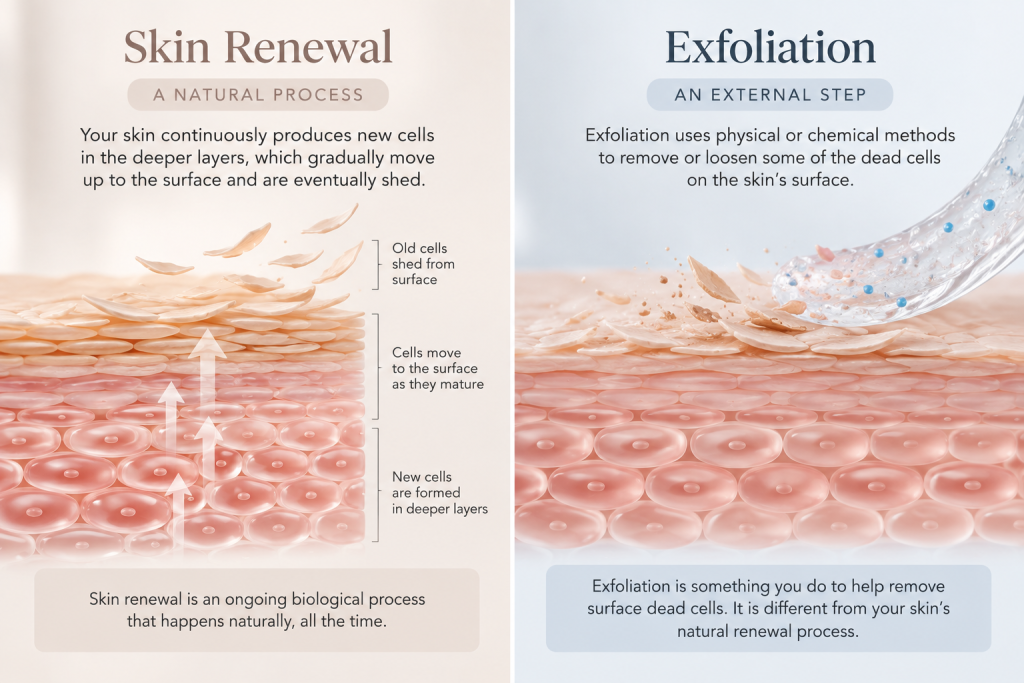
The terms skin renewal and exfoliation are sometimes used interchangeably, but they are not the same.
Skin renewal is a natural biological process that occurs continuously.
Exfoliation is something we do externally to remove or loosen some of the cells accumulated on the skin surface. This can be achieved through certain skincare ingredients or professional procedures.
Exfoliation may help improve the appearance of surface texture in appropriate circumstances, but more exfoliation does not necessarily mean better skin renewal. Over-exfoliation can irritate the skin and compromise the skin barrier.
This is why a balanced approach is generally more appropriate than trying to force the skin to renew more quickly.
Why Is Skin Renewal Important for Healthy-Looking Skin?
The skin is more than a surface that determines how we look. It is a dynamic organ that helps protect the body from the external environment and limit water loss.
The outermost layer of the epidermis, known as the stratum corneum, plays a particularly important role in maintaining the skin barrier. It helps regulate water loss while providing protection against external environmental factors.
When the skin’s renewal, hydration and barrier processes are functioning appropriately, the skin may appear:
- Smoother
- More supple
- More comfortable
- Less flaky
- More evenly textured
- More hydrated
- Fresher and healthier-looking
However, the appearance of the skin is influenced by many factors, so skin renewal should not be viewed as a single solution for every skin concern.
What Can Affect the Appearance of Your Skin?
Even though skin renewal happens naturally, several internal and external factors can influence how your skin looks and feels.
1. Age
Ageing is one factor associated with changes in epidermal turnover and skin barrier function.
Research suggests that ageing can affect skin hydration, lipid production, barrier recovery and epidermal cellular processes. These changes may contribute to dryness, roughness and other visible changes in skin quality.
This does not mean that ageing skin is unhealthy. Rather, skincare needs can change over time, and maintaining hydration and barrier support may become increasingly important.
2. UV Exposure
Singapore’s sunny climate means that UV exposure is an important consideration in everyday skincare.
Excessive UV exposure is associated with premature skin ageing, wrinkling and pigmentation changes. HealthHub Singapore recommends broad-spectrum sunscreen with at least SPF 30 as part of sun protection.
Consistent sun protection is therefore an important part of maintaining healthy-looking skin over time.
3. Dehydration and Dryness
Hydration has an important relationship with the skin barrier.
The stratum corneum contains natural moisturizing factors and lipids that help retain water. When the skin loses too much water, it can become dry, flaky and less comfortable. Adequate hydration also supports normal processes involved in skin maturation and shedding.
Dehydrated skin can therefore appear duller or more textured, even when there is no underlying skin disorder.
4. Skincare Habits
The way you care for your skin can also affect its appearance.
Using harsh cleansers, scrubbing aggressively or introducing multiple active ingredients at the same time may irritate the skin. Dermatologists generally recommend choosing skincare products according to individual skin type and introducing active products carefully.
A simpler, consistent routine can often be more sustainable than constantly changing products.
5. Environmental Factors
The skin is continually exposed to the environment.
Weather conditions, pollution, temperature changes and other environmental factors can influence skin hydration and barrier function. Research examining skin hydration has identified physiological, environmental, nutritional and ageing-related factors that can influence skin water content.
For people living in Singapore, this makes daily cleansing, moisturisation and sun protection useful foundations of a skincare routine.
How Can You Support Healthy Skin Renewal?
You cannot completely control the biological rate at which your skin renews itself. However, you can create conditions that support healthy skin function.
Keep Your Routine Consistent
A basic skincare routine does not need to contain a large number of products.
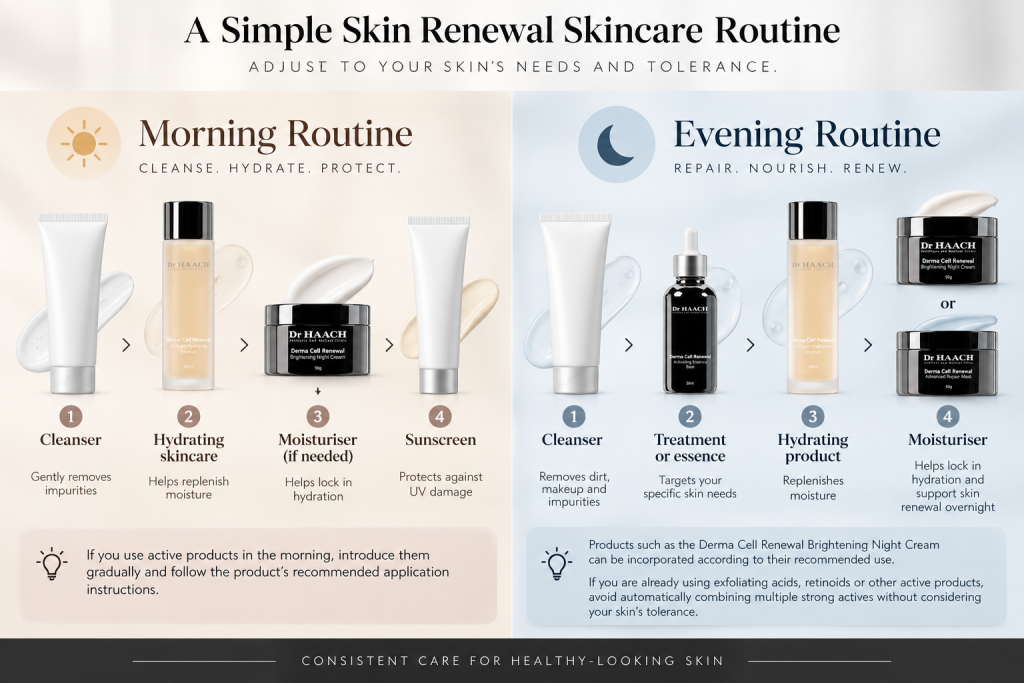
A practical routine can include:
- A gentle cleanser
- A hydrating product suited to your skin
- A moisturiser when appropriate
- Broad-spectrum sunscreen during the day
Additional products can be introduced depending on individual concerns and tolerance.
Prioritise Hydration
Hydration is an important part of maintaining the skin barrier.
HealthHub Singapore explains that moisturisers help hydrate the skin, improve barrier function and reduce further moisture loss.
Ingredients commonly used in hydrating skincare include humectants, emollients and occlusives, although the appropriate formulation depends on skin type and individual needs.
If your skin is frequently dry, tight, flaky or irritated, consider simplifying your routine rather than immediately adding more exfoliating products.
Protect Your Skin From UV Radiation
Daily sun protection is one of the most important habits for maintaining healthy-looking skin.
HealthHub Singapore recommends broad-spectrum, water-resistant sunscreen with at least SPF 30 and advises reapplication when appropriate, particularly after swimming or sweating.
Sun protection can also help reduce ongoing UV-related damage that contributes to visible pigmentation and premature skin ageing.
Avoid Over-Exfoliation
Exfoliation can be useful for certain skincare goals, but more is not necessarily better.
Using several exfoliating products simultaneously or exfoliating too frequently can lead to irritation and dryness. The American Academy of Dermatology also cautions that using too many anti-ageing products at once can irritate the skin.
If your skin becomes persistently red, stinging, peeling or uncomfortable after using an active product, consider stopping the product and seeking professional advice where appropriate.
Give Your Skin Time
Skincare generally requires consistency and realistic expectations.
A moisturiser may temporarily improve the appearance and feel of dry skin, while other skincare products may take longer to produce noticeable changes. The American Academy of Dermatology recommends following product directions and giving products sufficient time rather than continually changing routines.
Healthy-looking skin is usually better approached as an ongoing routine rather than a quick transformation.
Skin Renewal and the Skin Barrier: Why Both Matter
It can be tempting to focus entirely on removing dead skin cells when discussing skin renewal.
But the skin barrier is equally important.
The stratum corneum acts as a key protective barrier and helps minimise water loss from the skin. Its function depends on an organised combination of skin cells, lipids, natural moisturising factors and other components.
This is why aggressive exfoliation may be counterproductive. Removing surface cells without adequately supporting hydration and barrier function can leave the skin feeling dry or irritated.
A more balanced approach is to think about renewal, hydration and barrier support together.
How Hydration Supports Healthy-Looking Skin
Hydration does not “speed up” skin renewal in a simple or universal way. Instead, adequate water content in the outer skin layer helps support normal skin structure and function.
Research has found that water content in the stratum corneum is important for normal maturation and desquamation. When the skin becomes excessively dry, these processes can be affected and visible dryness or flaking may occur.
This is one reason moisturising can be an important part of a skin-renewal-focused routine.
What Should You Look for in Hydrating Skincare?
Depending on your skin type and skincare needs, different types of ingredients can contribute to hydration and skin comfort.
- Humectants, such as hyaluronic acid and beta-glucan, help support the skin’s water content.
- Emollients, such as certain plant oils, can help soften and smooth the skin surface.
- Barrier-supporting ingredients, such as niacinamide and beta-glucan, can help maintain the skin’s protective function.
The Dr HAACH Derma Cell Renewal Series includes examples from these categories. For instance, its Collagen Hydrating Essence contains beta-glucan and niacinamide, while the Brightening Night Cream contains hyaluronic acid and niacinamide. The Advanced Repair Mask also contains beta-glucan and macadamia seed oil.
There is no need to use every type of ingredient in every skincare routine. What matters is choosing products that are appropriate for your skin type, concerns and tolerance.
The Dr HAACH Approach to Skin Renewal
At Dr HAACH, we view skin renewal as part of a broader approach to maintaining healthy-looking skin rather than something that should be forced or accelerated at all costs.
Our Derma Cell Renewal Series is designed around several complementary skincare priorities, including hydration, barrier support, skin texture and a more even-looking complexion.
The collection currently includes products such as the Derma Cell Renewal Activating Essence Base, Derma Cell Renewal Collagen Hydrating Essence, Derma Cell Renewal Brightening Night Cream and Derma Cell Renewal Advanced Repair Mask.
Derma Cell Renewal Activating Essence Base
The Derma Cell Renewal Activating Essence Base is positioned as a pre-serum essence within the collection.
According to the product formulation information, it contains ingredients including niacinamide, Centella Asiatica, Cordyceps Militaris Extract and salicylic acid. The product is intended to support the appearance of clearer, smoother and more even-looking skin.
Because salicylic acid is an exfoliating active, individual tolerance should be considered when incorporating it into an existing skincare routine.
Derma Cell Renewal Collagen Hydrating Essence
The Derma Cell Renewal Collagen Hydrating Essence is a lightweight hydrating essence formulated with ingredients including niacinamide, beta-glucan, collagen and procollagen peptides and Pro-Xylane.
The formulation is intended to support hydration, moisture balance and a smoother-looking skin texture.
Hydrating products such as this can be considered as part of a broader routine focused on maintaining skin comfort and barrier support.
Derma Cell Renewal Brightening Night Cream
The Derma Cell Renewal Brightening Night Cream is designed for evening use and contains ingredients including hyaluronic acid, niacinamide, tranexamic acid and a vitamin C derivative.
It is formulated to support hydration and a more even-looking complexion while providing overnight skincare.
As with any active skincare product, individual skin tolerance matters, particularly when combining multiple products containing active ingredients.
Derma Cell Renewal Advanced Repair Mask
The Derma Cell Renewal Advanced Repair Mask focuses on hydration, skin comfort and barrier support.
Its listed ingredients include niacinamide, beta-glucan, Tremella polysaccharides, macadamia seed oil and allantoin, alongside other formulation components.
It can be considered as an additional step when the skincare routine calls for more intensive moisturising and comfort.
Explore the Dr HAACH Derma Cell Renewal Collection
How to Build a Simple Skin Renewal Skincare Routine
You do not necessarily need to use every product in a skincare collection.
A routine can be adjusted according to your skin’s needs and tolerance.
Does Skin Renewal Mean You Need to Exfoliate?
No.
Your skin naturally sheds older cells as part of normal epidermal turnover. You do not need to aggressively exfoliate to make this process happen.
Exfoliation can be useful for certain cosmetic concerns, but it should be viewed as an optional component of skincare rather than a requirement for healthy skin.
If your primary concern is persistent roughness, pigmentation, acne, redness or irritation, it may be more appropriate to seek professional assessment rather than repeatedly increasing exfoliation.
When Should You Consider Professional Skin Assessment?
Skincare can support the appearance and comfort of healthy skin, but cosmetic products should not be used as a substitute for medical evaluation of persistent skin conditions.
HealthHub Singapore notes that cosmetic products are not intended to treat or prevent health conditions, and individuals with concerns such as acne, eczema or other persistent skin problems should seek appropriate medical advice.
At Dr HAACH, professional skin treatments may also be considered depending on an individual’s skin condition and goals. For example, chemical peels are medical aesthetic procedures that use controlled chemical exfoliation and may be considered for selected concerns such as uneven texture, certain pigmentation concerns and dull-looking skin. Suitability, treatment depth, expected effects and recovery requirements depend on individual assessment.
Learn more about chemical peel treatment at Dr HAACH
A professional consultation is particularly relevant if your skin is persistently painful, inflamed, itchy, rapidly changing or not responding to a basic skincare routine.
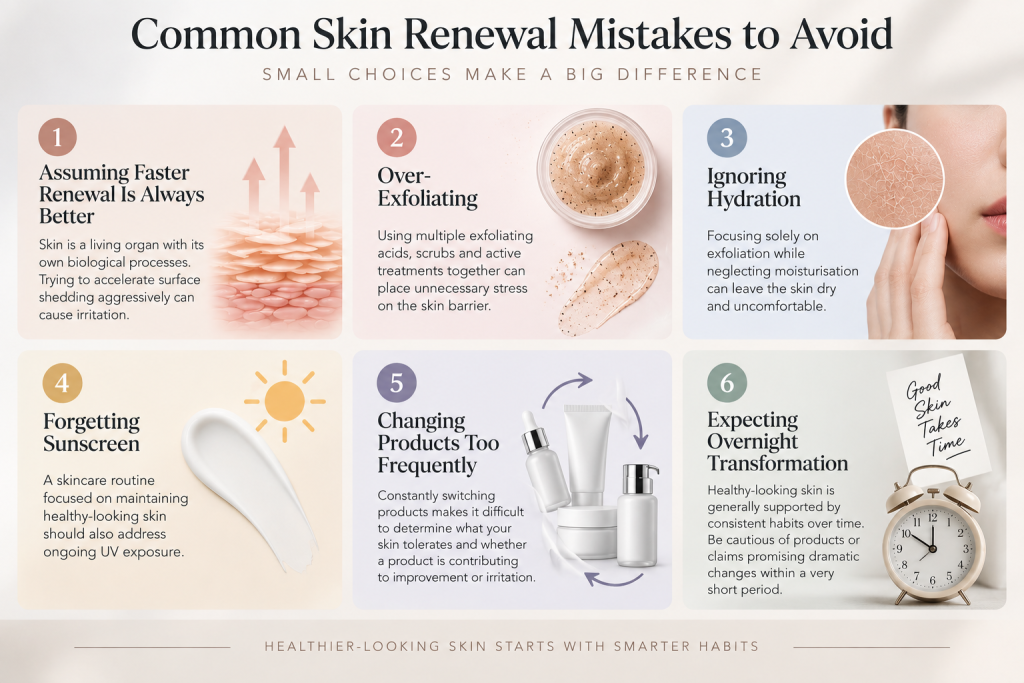
Common Skin Renewal Mistakes to Avoid
Frequently Asked Questions About Skin Renewal
What is skin renewal?
Skin renewal is the natural process through which the epidermis produces new cells, while older cells progressively move towards the surface and are eventually shed. This is part of normal skin maintenance and barrier function.
How long does the skin renewal cycle take?
There is no single skin renewal timeframe that applies to everyone. Epidermal turnover varies according to factors such as age, biological processes and skin condition. The commonly repeated “28-day cycle” should not be treated as a universal rule.
Does skin renewal slow down with age?
Ageing is associated with changes in epidermal turnover, hydration and skin barrier function. These changes can contribute to differences in skin texture, dryness and resilience over time.
Does exfoliation increase skin renewal?
Exfoliation removes or loosens cells at the skin surface, but this is different from the biological process of epidermal renewal. Exfoliation should be used appropriately because excessive exfoliation may cause irritation and barrier disruption.
Can moisturiser support skin renewal?
Moisturisers primarily help hydrate the skin and support barrier function. Maintaining adequate hydration is important for normal stratum corneum function and desquamation.
What is the best skincare routine for skin renewal?
There is no single routine that is appropriate for everyone. A practical foundation is gentle cleansing, adequate moisturisation, appropriate active ingredients and consistent sun protection. Products should be selected according to skin type, concerns and tolerance.
Can I use the Dr HAACH Derma Cell Renewal Series every day?
Some products in the Derma Cell Renewal Series are designed for routine skincare use, but application frequency depends on the specific product and its ingredients. For example, the Activating Essence Base contains salicylic acid, so users should follow the product’s directions and consider their existing active skincare products and skin tolerance.
Is skin renewal the same as skin regeneration?
The terms are sometimes used similarly in skincare marketing, but they are not necessarily interchangeable in a scientific context. Skin renewal generally refers to the ongoing replacement and shedding of epidermal cells, while regeneration can refer more broadly to the restoration or repair of tissue.
Can skincare products treat a skin condition?
Cosmetic skincare products may support hydration, comfort and the appearance of the skin, but they should not be considered a substitute for medical treatment of skin diseases. If you have a persistent or concerning skin problem, consult an appropriate healthcare professional.
Conclusion: Think Beyond Skin Renewal
Skin renewal is a natural and continuous biological process that helps maintain the epidermis and its protective barrier. But healthy-looking skin depends on more than simply removing dead skin cells or trying to accelerate turnover.
Age, UV exposure, hydration, environmental factors, lifestyle and skincare habits can all influence how your skin looks and feels.
For a practical approach to skin renewal, focus on the fundamentals:
- Keep your skincare routine consistent
- Support skin hydration
- Protect your skin from UV exposure
- Avoid excessive exfoliation
- Introduce active ingredients thoughtfully
- Give products time to work
- Seek professional advice when persistent skin concerns require assessment
At Dr HAACH, the Derma Cell Renewal Series is formulated around complementary skincare priorities such as hydration, barrier support, skin texture and a more even-looking complexion. It can be incorporated into a broader daily skincare routine according to individual needs and product directions.
Healthy-looking skin is not about constantly forcing the skin to renew faster. It is about supporting the skin’s natural processes while protecting and caring for it consistently.
Explore Dr HAACH skincare products
References:
- HealthHub Singapore — Moisturisers
- HealthHub Singapore — Sunscreens
- HealthHub Singapore — Cosmetic Products
- American Academy of Dermatology — How to Select Anti-Aging Skin Care Products
- PubMed — Skin Hydration: A Review on Its Molecular Mechanisms
- PubMed — The Skin Barrier and Moisturization: Function, Disruption, and Mechanisms of Repair