



Introduction
You sleep for seven or eight hours, wake up feeling reasonably rested, and yet the mirror still shows dark circles under your eyes.
So, why do you have dark circles even when you get enough sleep?
The answer is that sleep is only one of many possible factors behind dark eye circles. Dark circles are often multifactorial, meaning that several factors can contribute at the same time. These may include genetics, pigmentation, visible blood vessels, thinner skin, allergies or irritation, sun exposure, ageing and the natural structure of the area beneath the eyes. In some people, what looks like pigmentation may actually be a shadow caused by under-eye hollows or changes in facial volume.
This is particularly relevant when looking at the causes of dark eye circles in Asian skin. Pigmentation and post-inflammatory changes can contribute to periorbital darkness, while the anatomy of the under-eye area can create shadows that are not simply a matter of skin colour.
At Dr HAACH, we believe understanding why the under-eye area looks darker is an important first step before considering aesthetic options. Different causes may call for different approaches, and not every dark circle requires an aesthetic treatment.
Why Do I Have Dark Circles Even If I Sleep Enough?
Getting sufficient sleep can support overall health, but it does not necessarily prevent dark circles.
Singapore’s HealthHub recommends that adults strive for at least seven hours of sleep each day, while also emphasising that sleep quality matters.
Sleep deprivation can make existing under-eye darkness more noticeable, but adequate sleep does not remove genetic, pigmentary, vascular or structural causes of dark circles.
For example, if your under-eye darkness is mainly related to pigmentation or the natural shape of your eye socket, sleeping longer may have little effect on its appearance.
Research reviews describe infraorbital dark circles as a complex issue involving several possible components, including pigmentation, thin or translucent skin, visible vascular structures and shadowing caused by tear troughs or changes in the soft tissues around the eyes.
In other words:
You can be well-rested and still have dark circles.
The important question is therefore not simply “Am I getting enough sleep?” but also “What is making the area under my eyes look darker?”
What Are the Main Causes of Dark Eye Circles?
There is no single cause that explains every case. The causes of dark eye circles can broadly be grouped into several categories.
1. Genetics and Natural Skin Characteristics

Some people naturally have more visible darkness around their eyes because of inherited characteristics.
If your parents or close family members have prominent dark circles, genetics may play a role in your own appearance.
The skin around the eyes is also relatively thin. When the skin is thin or translucent, underlying blood vessels and tissues can become more visible, contributing to a darker or bluish appearance.
This means that even a person with excellent sleep habits and a healthy lifestyle may naturally have noticeable under-eye darkness.
2. Under-Eye Pigmentation

Sometimes, dark circles are genuinely related to increased pigmentation.
Periorbital hyperpigmentation refers to increased darkness around the eyes. Research suggests that pigmentary factors can be particularly relevant in people with darker skin tones and may occur alongside other causes.
Pigmentation may be influenced by:
- Genetic predisposition
- Sun exposure
- Previous inflammation
- Skin irritation
- Certain dermatological conditions
- Post-inflammatory hyperpigmentation
If the darkness remains relatively similar regardless of lighting, facial expression or sleep, pigmentation may be one factor worth considering.
However, visual assessment alone cannot always determine the precise cause.
3. Sun Exposure

UV exposure can contribute to pigmentation and uneven skin tone.
The under-eye area may receive repeated environmental exposure over time, and cumulative sun exposure can contribute to changes in skin pigmentation and ageing.
For people concerned about dark circles under the eyes, daily sun protection is therefore an important part of a broader skincare routine.
A broad-spectrum sunscreen with appropriate SPF, together with physical protection such as sunglasses, can help reduce ongoing UV exposure. Mayo Clinic also recommends sun protection as part of self-care for dark circles.
4. Allergies, Eczema and Eye Rubbing

Do you frequently experience itchy or irritated eyes?
Allergies and inflammatory skin conditions can contribute to under-eye darkness. Repeated rubbing or scratching may further irritate the delicate skin around the eyes.
Darkening can also occur after inflammation through a process known as post-inflammatory hyperpigmentation. Reviews of periorbital hyperpigmentation have identified atopic dermatitis and allergic contact dermatitis among possible contributing factors.
If you have persistent:
- Itching
- Redness
- Scaling
- Swelling
- Irritation
- Watery eyes
it may be more appropriate to address the underlying condition with a qualified healthcare professional rather than treating the darkness as a purely cosmetic concern.
5. Visible Blood Vessels
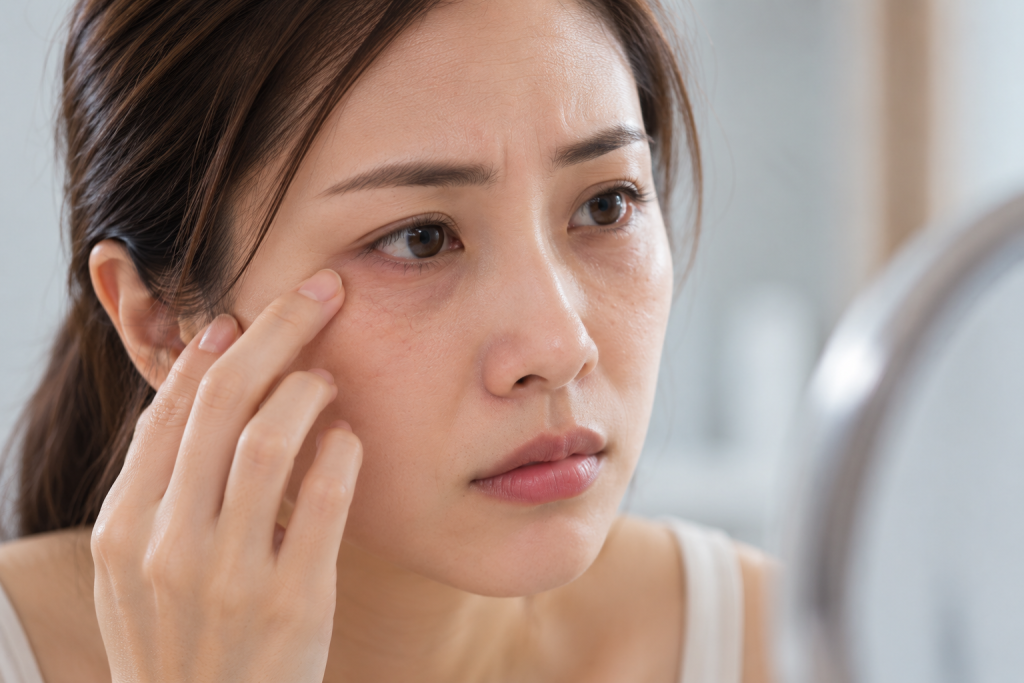
Not every dark circle is brown pigmentation.
The thin skin beneath the eyes can make underlying blood vessels more visible. Depending on skin thickness and individual anatomy, this may produce a blue, purple or darker appearance.
This is one reason two people can have similarly dark-looking under-eyes but require completely different approaches.
A review of infraorbital dark circles identifies vascular visibility as one of several potential contributors.
6. Tear Troughs and Under-Eye Hollows
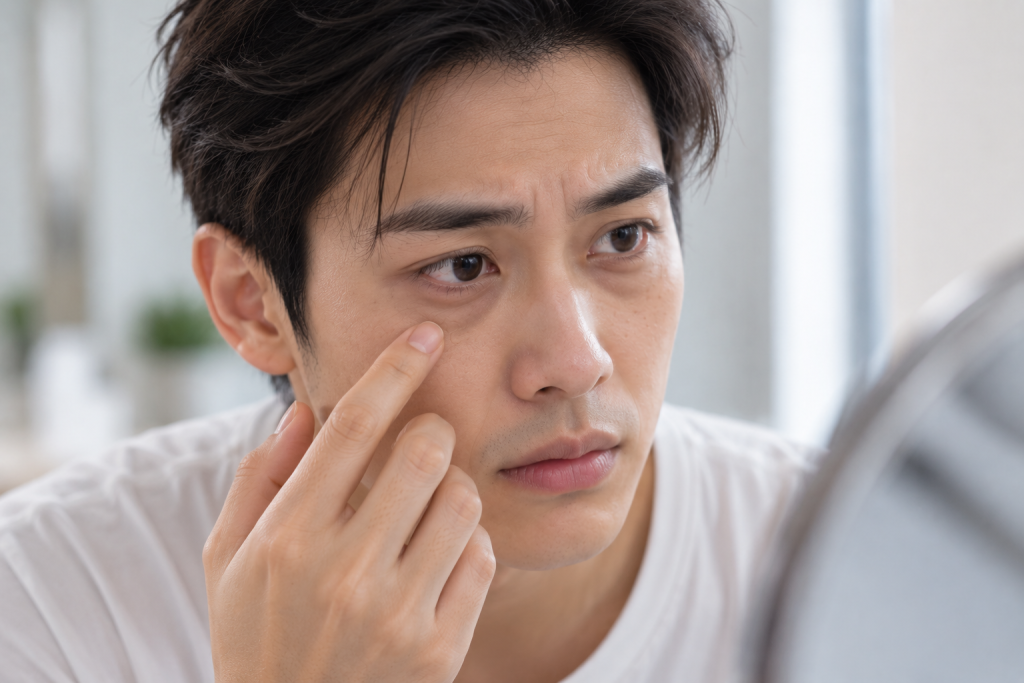
Sometimes, the skin itself is not significantly darker.
Instead, under-eye hollows can create shadows that make the area appear dark.
The tear trough is the depression that can occur between the lower eyelid and upper cheek. Changes in facial structure, soft tissue and volume with age can make this depression more noticeable.
In these cases, standing under overhead lighting can make the darkness appear particularly pronounced because the hollow creates a shadow.
This distinction matters because pigmentation-focused skincare may not address a shadow that is primarily caused by facial anatomy.
Research reviews identify tear-trough shadowing and volume loss as important structural contributors to infraorbital dark circles.
7. Ageing and Changes Around the Eyes
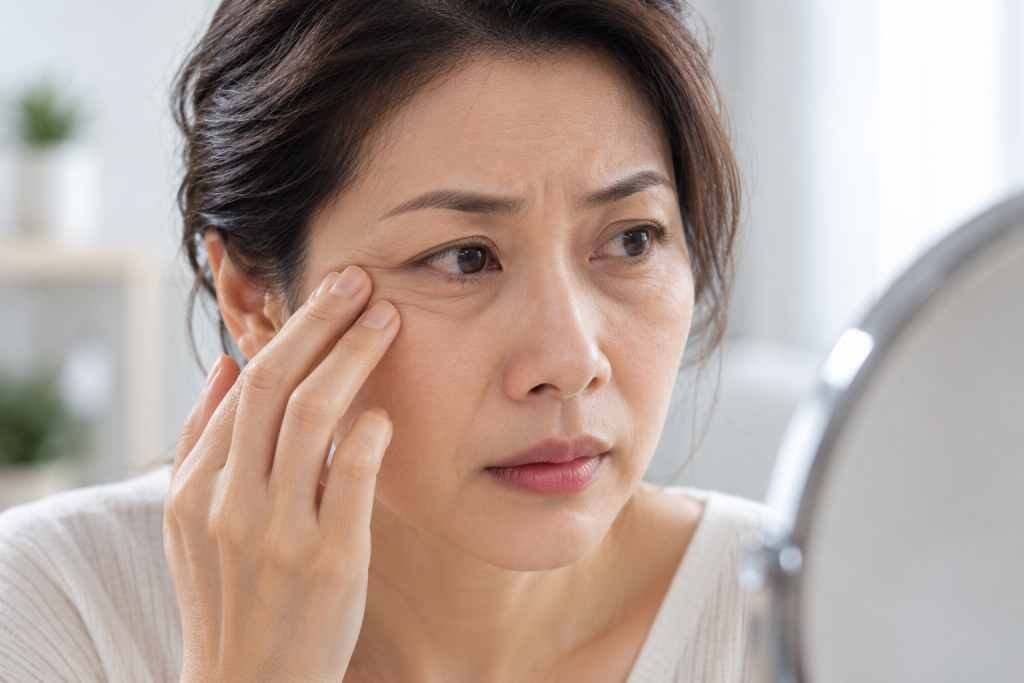
As we age, the tissues around the eyes can change.
Skin may become thinner and lose some of its elasticity, while changes in soft-tissue volume and the contours around the eyes can make hollows, shadows and bags more noticeable.
This can create the familiar combination of:
- Dark circles
- Under-eye hollows
- Fine lines
- Eye bags
- Skin laxity
Importantly, these may not all have the same cause.
A person may have pigmentation and a tear trough, for example. This is why simply applying a brightening product may not completely change the appearance of the area.
8. Lifestyle Factors Beyond Sleep

Sleep is important, but it is not the only lifestyle factor that can affect how the eye area looks.
Stress, smoking and excessive alcohol consumption have been associated with more noticeable dark circles or factors that can worsen their appearance.
Your overall sleep quality also matters.
Someone may spend eight hours in bed but have fragmented or poor-quality sleep. HealthHub notes that sleep quality and quantity both contribute to whether a person feels adequately rested.
However, persistent dark circles should not automatically be attributed to lifestyle.
If the darkness has been present for years, genetics, pigmentation or facial anatomy may be more relevant.
How Can You Tell What Is Causing Your Dark Circles?
There is no reliable home test that can identify every cause of dark circles.
However, you can observe a few characteristics.
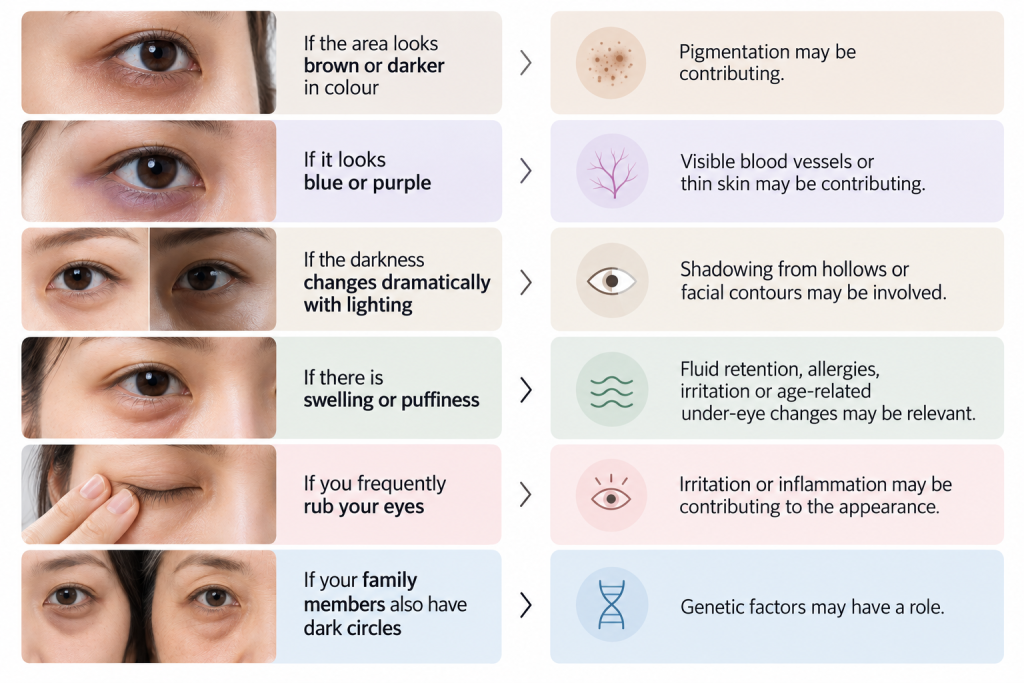
These observations are only general indicators, not a diagnosis. Dark circles commonly have more than one contributing factor, which is why professional assessment can be useful when they are persistent or bothersome.
What Can You Do About Dark Circles at Home?
If you have dark circles even when you sleep enough, start with the basics before assuming you need an aesthetic procedure.
1. Maintain Consistent Sleep
Continue aiming for sufficient sleep rather than assuming that dark circles mean you need to sleep significantly longer.
For adults, HealthHub recommends aiming for at least seven hours each day.
If you consistently sleep for an adequate duration but remain excessively tired, or if you have persistent sleep difficulties, consider discussing this with a healthcare professional.
2. Protect the Under-Eye Area From UV Exposure
Daily sun protection is important when pigmentation is part of the concern.
Consider:
- Broad-spectrum sunscreen
- Sunglasses
- A hat when outdoors
- Avoiding prolonged direct sun exposure
Sun protection is particularly relevant when pigmentation is involved.
3. Avoid Rubbing Your Eyes
If your eyes are itchy or irritated, repeatedly rubbing them can aggravate the surrounding skin.
Instead, identify and address potential causes of irritation with appropriate medical advice when necessary.
4. Keep Your Skincare Routine Gentle
The skin around the eyes is delicate.
Avoid introducing multiple strong active ingredients around the eye area simply because they are marketed for pigmentation elsewhere on the face.
If you experience burning, redness or persistent irritation after using a product, discontinue it and seek appropriate professional advice.
5. Use a Cold Compress for Temporary Puffiness
A cool compress may temporarily reduce the appearance of puffiness.
This is more relevant when swelling contributes to the appearance of darkness rather than when the primary issue is pigmentation or structural shadowing.
What Treatments Are Available for Dark Eye Circles in Singapore?
The right approach to dark circles depends largely on what is causing the under-eye area to look darker. Pigmentation, visible blood vessels, thin skin, puffiness and under-eye hollows can contribute to a similar-looking concern, but they may require different approaches.
Depending on the underlying cause, treatment options that have been studied include topical skincare, chemical peels, laser-based treatments and fillers. A systematic review of periorbital hyperpigmentation found that these approaches may be considered for different presentations, although the available evidence varies between treatments. A professional assessment can help determine which options may be appropriate for the individual’s concerns.
Broadly, treatment approaches may include:
Pigment-focused approaches
These may be considered when increased pigmentation is a significant contributor.
Depending on the individual, a doctor may discuss appropriate topical skincare, peels or light/laser-based approaches.
Structural approaches
When hollows or volume loss create significant shadowing, injectable treatments such as fillers may sometimes be considered.
The evidence indicates that fillers are more relevant to dark circles associated with volume loss rather than pigment-based darkness.
Skin-quality approaches
Where thin, ageing or lax skin contributes to the appearance, treatments may focus on skin texture, quality or collagen-related changes, depending on professional assessment.
Combination approaches
Because dark circles can have pigmentary, vascular and structural components simultaneously, more than one approach may sometimes be considered.
Importantly, the evidence base for many aesthetic treatments remains variable, and outcomes can differ between individuals.
How Dr HAACH Approaches Dark Eye Circles
At Dr HAACH, we recognise that dark circles should not automatically be treated as a simple sleep-related problem.
When someone seeks advice about persistent under-eye darkness, the relevant question is what may be contributing to its appearance — whether pigmentation, under-eye hollowness, skin changes, vascular visibility or a combination of factors.
For suitable individuals, Dr HAACH may offer aesthetic options such as Tear Trough / HyFillers or Fotona 4D SmoothEye, depending on the individual’s concerns and professional assessment.
These are not interchangeable treatments, and neither should be assumed to be appropriate for every type of dark circle.
Tear Trough / HyFillers
If under-eye hollowness and the resulting shadow are significant contributors, a qualified practitioner may consider a filler-based approach.
The principle is different from treating pigmentation: the objective is to address the structural contour that contributes to shadowing.
Published reviews support the use of soft-tissue fillers primarily when volume loss is an important cause of under-eye darkness.
Because the area around the eyes is anatomically delicate, suitability, risks, alternatives and expected outcomes should be discussed during a professional consultation.
Fotona 4D SmoothEye
Laser-based approaches may be considered when skin quality and related under-eye concerns are part of the assessment.
Evidence reviews indicate that light- and laser-based technologies have been investigated for periorbital pigmentation and other under-eye concerns, although effectiveness can vary according to the underlying cause and treatment modality.
At Dr HAACH, treatment suitability should be determined based on an individual’s concerns and professional assessment rather than assuming that every case of dark circles requires the same procedure.
Do Eye Creams Work for Dark Circles?
Eye creams may be useful for certain aspects of under-eye appearance, but their effect depends heavily on what is causing the darkness.
Some topical ingredients have been studied for periorbital pigmentation and related concerns. Recent reviews have reported potential benefits from various topical approaches, while also emphasising the need for further research and for treatments to be matched to the underlying cause.
An eye cream is therefore more likely to be relevant when the concern involves the skin itself than when the main issue is a deep tear through creating a shadow.
In simple terms:
Pigment problem → skincare may have a role.
Structural hollow → skincare cannot physically fill the hollow.
Puffiness → addressing contributing factors may be more relevant.
Multiple causes → a combination approach may be considered.
When Should You See a Doctor About Dark Circles?
Most dark circles are a cosmetic concern rather than a sign of a serious medical problem.
However, you should seek medical advice if the change is unusual or accompanied by other symptoms.
In particular, Mayo Clinic advises seeking professional assessment when darkness occurs around only one eye and becomes progressively worse.
You should also consider medical evaluation if you have:
- Persistent swelling
- Significant redness or irritation
- Pain
- Vision changes
- A skin rash
- Sudden or unusual changes around the eye
- Other symptoms that concern you
Dark circles should not automatically be assumed to be caused by lack of sleep.
Dark Circles in Singapore: Why a Personalised Assessment Matters
Singapore’s climate and lifestyle can expose the skin to strong sunlight, while busy schedules may also affect sleep, stress and skincare habits.
But there is no single “Singapore cause” of dark circles.
The same visible symptom can have completely different underlying contributors in different people.
One person may primarily have pigmentation. Another may have a pronounced tear trough. Someone else may have thin skin with visible vascular structures. Another may have a combination of these factors.
This is why searching for dark circles treatment Singapore should go beyond simply looking for a procedure.
The more useful question is:
What type of dark circle do I have, and what approach is appropriate for that cause?
At Dr HAACH, we encourage individuals to seek a professional assessment before deciding on an aesthetic treatment.
Frequently Asked Questions About the Causes of Dark Eye Circles
Why do I have dark circles even though I sleep 8 hours?
Adequate sleep does not eliminate other causes of dark circles. Genetics, pigmentation, thin skin, visible blood vessels, allergies, sun exposure, ageing and under-eye hollows can all contribute.
Can lack of sleep cause dark circles?
Sleep deprivation can make existing dark circles appear more noticeable, but it is only one possible contributing factor. HealthHub recommends that adults aim for at least seven hours of sleep each day.
What are the main causes of dark eye circles?
Common contributing factors include genetics, pigmentation, thin skin, visible blood vessels, allergies or dermatitis, rubbing the eyes, sun exposure, ageing and structural shadowing from tear troughs or under-eye hollows.
Are dark circles caused by dehydration?
Dehydration is often mentioned as a potential contributor to a tired-looking appearance, but dark circles are multifactorial and should not automatically be attributed to dehydration. Established causes include pigmentation, vascular visibility, thin skin, genetics and structural shadowing.
Can allergies cause dark circles?
Allergies and eye irritation can contribute to under-eye darkness, particularly when they lead to inflammation or repeated rubbing.
Can dark circles be genetic?
Yes. Genetics can influence the appearance of the under-eye area, including pigmentation, skin characteristics and facial anatomy.
Can skincare remove dark circles?
Skincare may help improve certain pigmentary or skin-quality components, but its usefulness depends on the underlying cause. Structural shadows caused by significant under-eye hollows, for example, cannot be physically corrected with a topical cream.
What treatment is suitable for dark eye circles?
There is no universal treatment. Depending on the cause, options may include skincare, pigment-focused treatments, light or laser-based approaches, or structural treatments such as fillers for appropriate cases of volume loss. A professional assessment is important before selecting a treatment.
Are tear trough fillers suitable for everyone with dark circles?
No. Tear trough fillers are primarily relevant when under-eye hollowness and volume loss contribute to shadowing. They are not a universal treatment for pigment-based dark circles.
When should I seek medical advice for dark circles?
Seek medical advice if the darkness is new or unusual, particularly if it affects only one eye and becomes progressively worse, or if it occurs with symptoms such as irritation, swelling, pain or vision changes.
Conclusion: Dark Circles Are Not Always About Sleep
If you are wondering, “Why do I have dark circles even when I get enough sleep?”, the answer may have little to do with the number of hours you spend in bed.
The causes of dark eye circles can include genetics, pigmentation, sun exposure, allergies, eye rubbing, visible blood vessels, thin skin, ageing and structural changes such as tear troughs.
That is why getting more sleep may not make your dark circles disappear.
Instead of assuming that every dark circle is caused by fatigue, consider the characteristics of your under-eye area and whether pigmentation, shadowing, puffiness or another factor may be contributing.
At Dr HAACH, our approach is to consider the individual’s concerns and the factors contributing to the appearance of the under-eye area before discussing suitable aesthetic options. Where appropriate, treatments such as Tear Trough / HyFillers or Fotona 4D SmoothEye may be discussed based on professional assessment.
If your dark circles are persistent or bothering you, a consultation can help you understand the possible contributing factors and the options that may be appropriate for your individual needs.
This article provides general educational information and is not intended to diagnose or treat any medical condition. Individual suitability for aesthetic treatments varies. A qualified healthcare professional should assess your concerns before treatment.
References:
- HealthHub Singapore — Sleep and Sleep Health
- HealthHub Singapore — Sleeping Well for Adults
- Mayo Clinic — Dark Circles Under Eyes: Causes
- PubMed — Infraorbital Dark Circles: Definition, Causes and Treatment Options
- PubMed — Treatments of Periorbital Hyperpigmentation: A Systematic Review
- PubMed — Infraorbital Dark Circles: Review of Pathogenesis, Evaluation and Treatment