


If you have noticed that your pores seem more visible than they used to, you are not alone. Large pores are a common cosmetic concern, particularly around the nose, cheeks, forehead and other areas where oil production tends to be higher.
But why do pores look bigger in the first place?
The answer is not simply “dirty skin” or a lack of cleansing. Pore appearance can be influenced by several factors, including sebum production, genetics, skin elasticity, ageing, sun exposure, acne and clogged pores. Research has also found associations between visible pore size, sebum production and changes in skin elasticity, as discussed in this peer-reviewed PubMed research on facial pores.
At Dr HAACH, we believe that understanding why pores look enlarged is an important first step before deciding how to manage them. This article explains the common causes of large pores, practical skincare measures that may help, and when professional assessment may be worth considering.
What Are Pores?
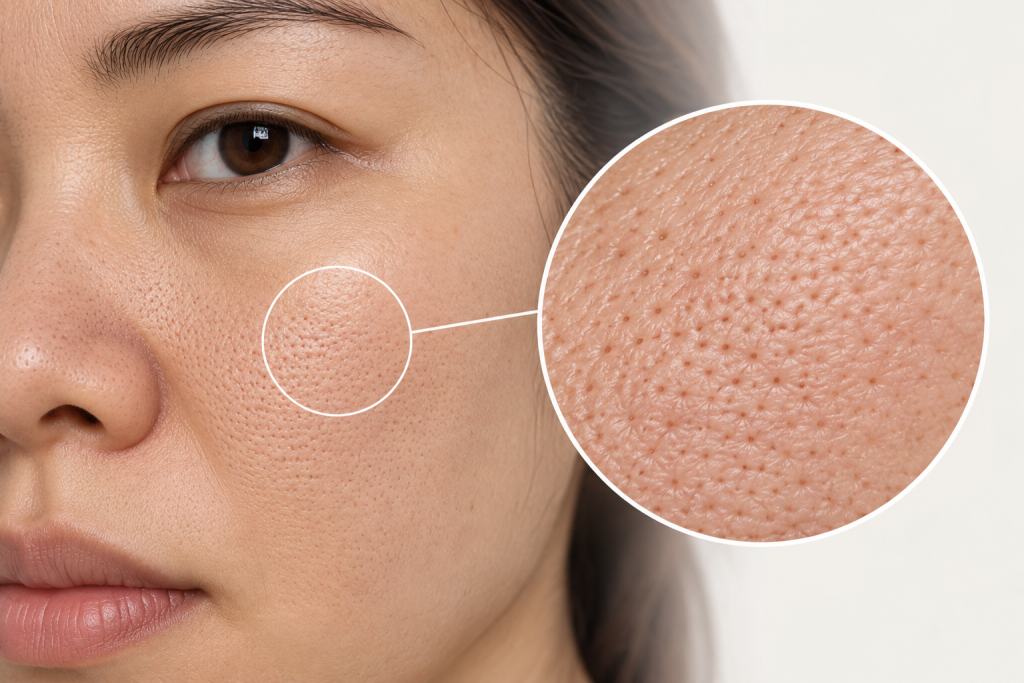
Pores are the visible openings of structures associated with hair follicles and sebaceous glands. Sebaceous glands produce sebum, an oily substance that helps lubricate and protect the skin.
Pores are a normal part of skin anatomy. They cannot simply be removed, and the goal of skincare is generally not to make pores “disappear”, but to help make them less noticeable where possible.
The appearance of facial pores can vary considerably between individuals. Research has identified several factors that may contribute to visible pore size, including increased sebum production, reduced skin elasticity and changes in the size of the hair follicle, as outlined in this peer-reviewed research on facial pore size.
Why Do My Pores Look Bigger?
There is rarely one single explanation for large pores. Several factors can contribute at the same time.
1. Excess Sebum and Oily Skin
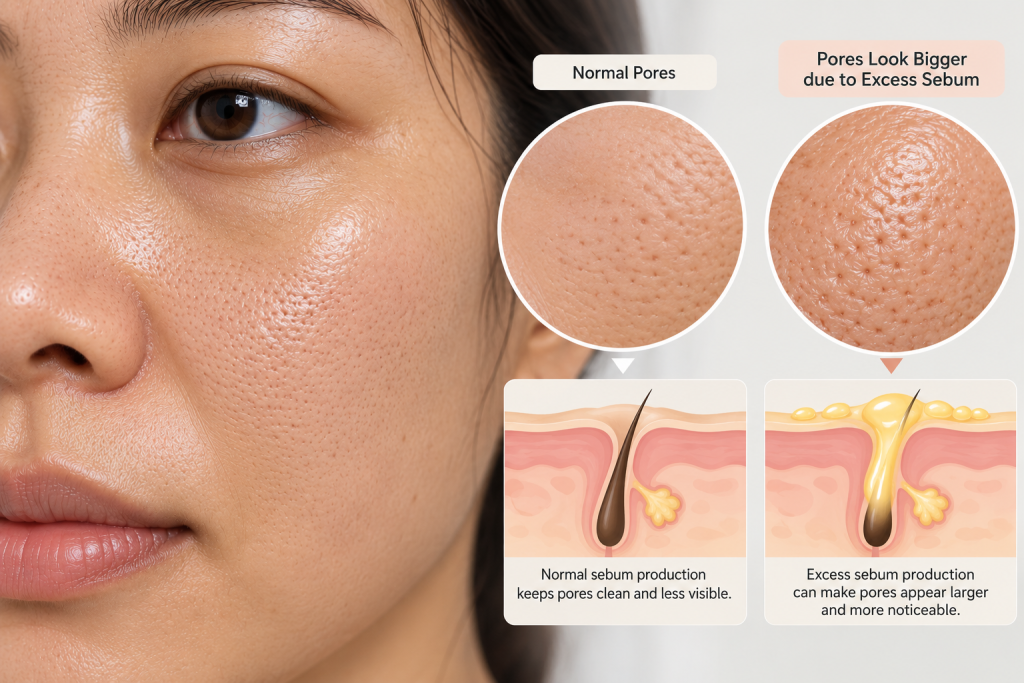
One of the more consistently studied factors associated with visible pore size is sebum production.
When the skin produces more oil, pores may become more noticeable, particularly around the nose, forehead and cheeks. A study examining facial pore size found a significant association between increased sebum output and larger pore size, as reported in this peer-reviewed study on sebum production and facial pore size.
This may help explain why pores sometimes look particularly obvious later in the day, when oil has accumulated on the skin.
However, having oily skin does not automatically mean you will have large pores. Genetics and other factors also play a role.
What can you do?
Instead of trying to remove all oil from your skin, aim for balanced oil control.
A gentle cleanser and appropriately selected skincare products may be more useful than repeatedly washing or aggressively scrubbing the face.
2. Genetics and Your Natural Skin Structure
Some people naturally have more visible pores than others.
Genetic factors can influence characteristics such as:
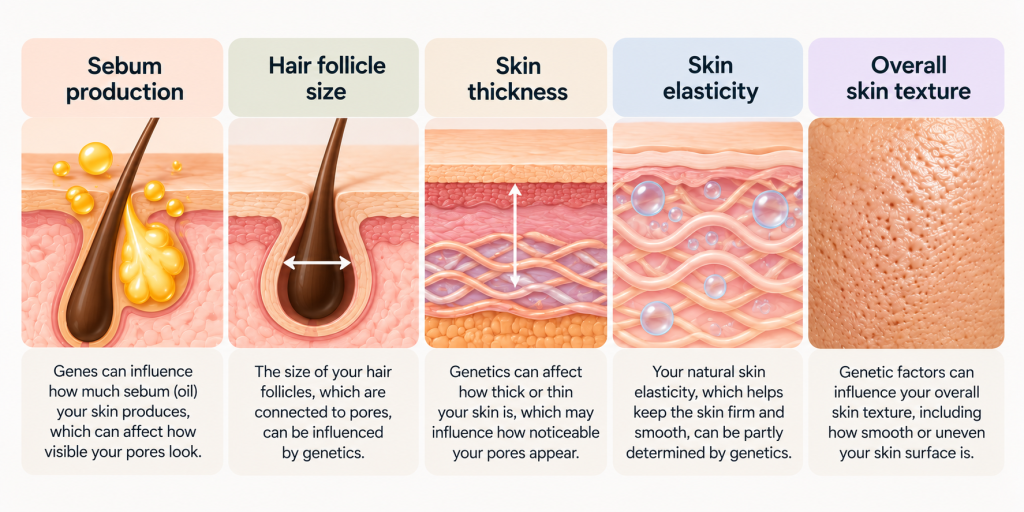
This means that two people can follow very similar skincare routines while having noticeably different pore visibility.
If you have always had visible pores, genetics and your natural skin structure may be part of the explanation.
3. Ageing and Reduced Skin Elasticity
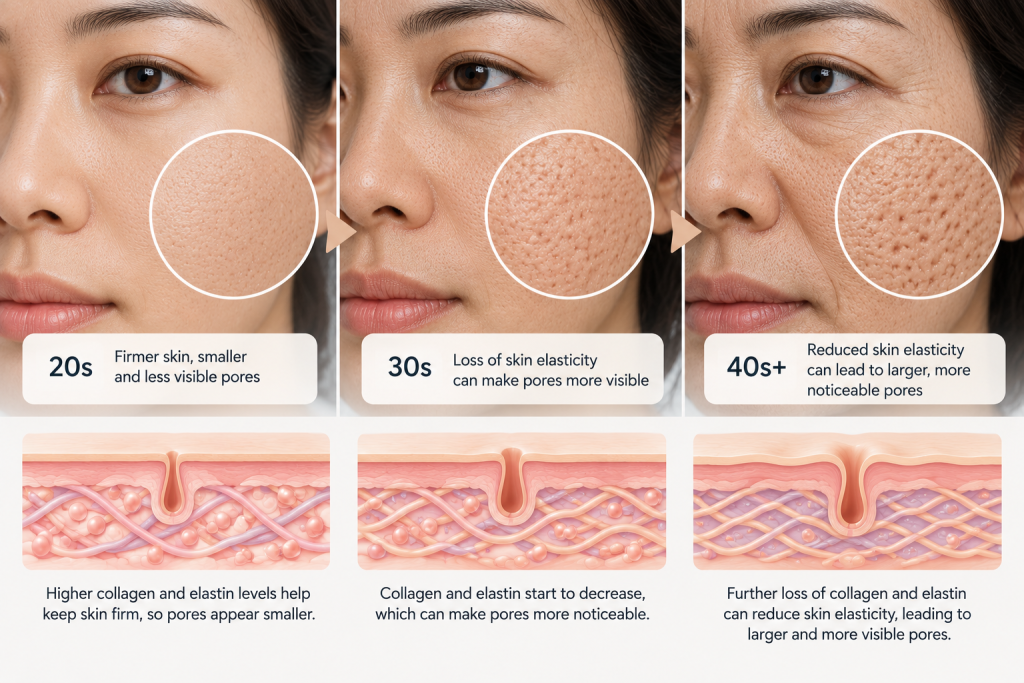
Pores may become more noticeable as skin changes with age.
As skin gradually loses elasticity and firmness, the surrounding tissue may provide less structural support around the follicular opening. This can make existing pores appear larger or more elongated.
Research examining facial pores has identified reduced skin elasticity as one of the factors associated with increased pore visibility. (PubMed)
This is one reason why someone may notice a change in pore appearance even if their oil production has not changed significantly.
An important distinction
Large pores are not necessarily a sign that your skin is “dirty” or unhealthy.
Sometimes the issue is less about what is inside the pore and more about changes in the skin surrounding it.
4. Sun Exposure and Photoageing
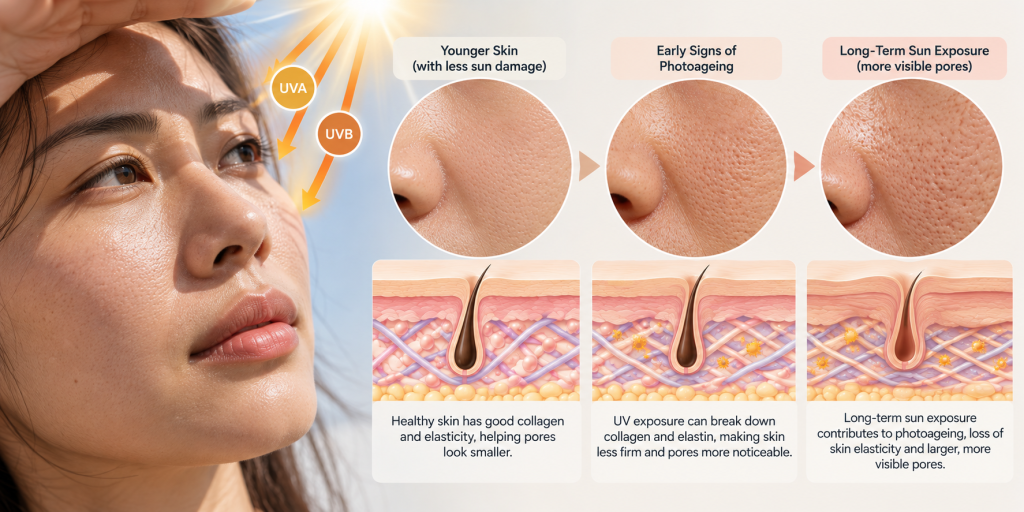
Singapore’s year-round UV exposure makes daily sun protection particularly relevant to long-term skin health.
UV exposure contributes to photoageing, including changes affecting skin structure, firmness and elasticity. HealthHub’s guidance on sunscreen and sun protection recommends using broad-spectrum sunscreen with at least SPF 30 as part of daily sun protection. As part of a broader skincare routine, the Dr HAACH Derma Cell Renewal Collagen Hydrating Essence, formulated with Beta-Glucan and Pro-Xylane, may be incorporated to support skin hydration, suppleness and overall skin quality. It is important to note that hydrating skincare does not replace sunscreen, which remains an essential step for protecting skin from ongoing UV exposure.
As skin loses firmness, pores may become more visually prominent.
This does not mean sunscreen will immediately make your pores look smaller. Rather, consistent sun protection is part of protecting the skin from UV-related damage that can contribute to visible signs of ageing.
Can Clogged Pores Make Pores Look Bigger?
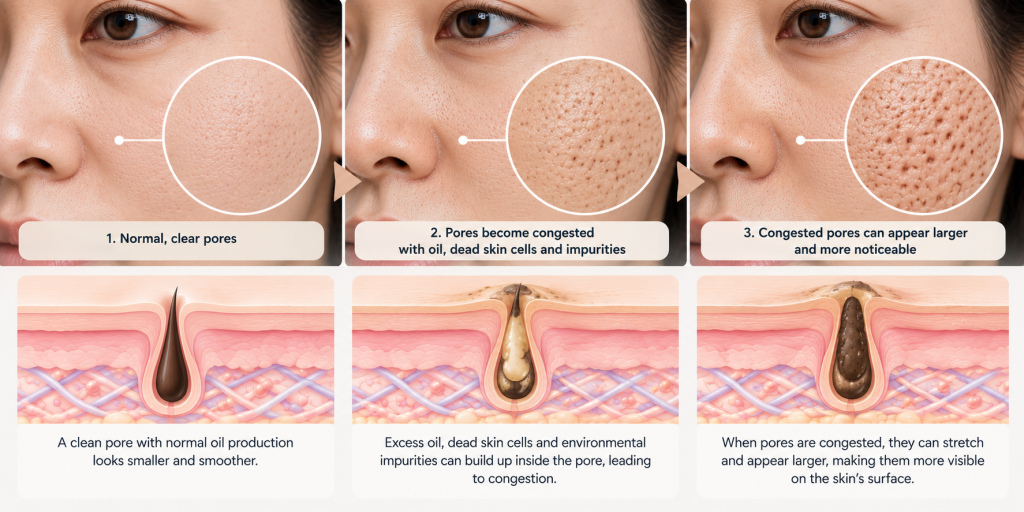
Yes, congestion can make pores appear more noticeable.
When sebum and dead skin cells accumulate inside a follicular opening, the pore may become more visible. This can contribute to blackheads and other forms of congestion.
Blackheads are not simply dirt trapped inside the skin. They are open comedones in which material inside the follicle reacts with oxygen, producing the characteristic dark appearance. (American Academy of Dermatology)
This is why simply scrubbing harder is not the answer.
In fact, excessive scrubbing or picking can irritate the skin and potentially make the overall appearance of the skin worse. HealthHub similarly advises against harsh scrubbing for acne-prone skin. (HealthHub)
Large Pores vs Blackheads: Are They the Same?
Not exactly.
They can look similar, especially around the nose and cheeks, but they are not the same thing.
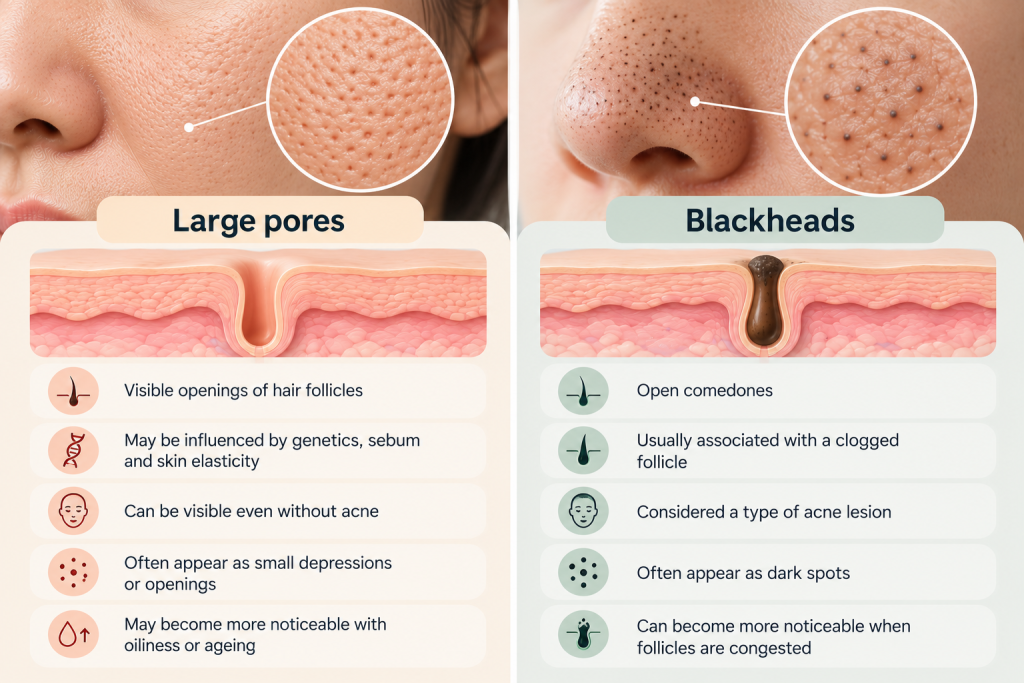
It is also possible to have both visible pores and blackheads.
If you are unsure what you are seeing, avoid repeatedly squeezing or extracting the area yourself.
Does Washing Your Face More Often Make Pores Smaller?
Not necessarily.
It can be tempting to wash oily skin repeatedly in an attempt to remove excess oil. However, more cleansing is not always better.
HealthHub’s guidance on acne and skincare recommends a regular, gentle skincare routine and advises against harsh scrubbing, particularly for acne-prone skin. Similarly, the American Academy of Dermatology’s guidance on large facial pores recommends gentle cleansing rather than aggressive scrubbing, as irritation can make pores appear more noticeable.
A practical approach
For most people, focus on:
- A gentle cleanser
- Appropriate moisturisation
- Daily sunscreen
- Products suited to your skin type
- Avoiding unnecessary physical scrubbing
If your skin feels tight, burning or excessively dry after cleansing, your routine may be too aggressive.
How to Make Large Pores Look Less Noticeable
There is no single skincare ingredient or treatment that works for every person. The most appropriate approach depends on what is contributing to the appearance of the pores.
1. Use Non-Comedogenic Skincare
If your skin is oily or prone to congestion, consider products labelled non-comedogenic.
These products are formulated with the aim of reducing the likelihood of clogging pores. The American Academy of Dermatology recommends non-comedogenic skincare and makeup for people concerned about visible pores. (American Academy of Dermatology)
This can be particularly useful when your concern involves both oily skin and congestion.
2. Consider Salicylic Acid for Congestion
Salicylic acid is commonly used in acne skincare because of its ability to help exfoliate and clear blocked pores.
HealthHub lists salicylic acid among topical acne preparations that can help remove dead skin cells and clear blocked pores. (HealthHub)
However, stronger or more frequent use is not automatically better.
If your skin becomes excessively dry, irritated or uncomfortable, reduce use or seek professional advice about whether the product is appropriate for your skin.
3. Consider a Pore-Focused Active
If congestion and excess oil are contributing to the appearance of your pores, skincare containing ingredients such as salicylic acid may be considered. Salicylic acid can help exfoliate the skin and clear blocked pores, while niacinamide is commonly used in skincare to support the appearance and condition of the skin.
Within the Dr HAACH DermaCell Renewal Series, the DermaCell Renewal Activating Essence Base contains salicylic acid and niacinamide, making it a relevant option to consider as part of a skincare routine for skin that appears congested or oily. However, individual skin types respond differently to active ingredients, so it is important to introduce active skincare appropriately and avoid combining too many potentially irritating products at once.
The aim is not to permanently “close” pores, but to help manage factors such as congestion and excess oil that can make pores appear more noticeable.
4. Consider Retinoid-Based Skincare Where Appropriate
Retinoids can be useful for certain acne and skin-texture concerns, and dermatologists may recommend them as part of managing visible pores.
The American Academy of Dermatology notes that topical retinoids may help make pores less noticeable, particularly where oily skin, mild acne or reduced skin firmness are contributing factors. (American Academy of Dermatology)
However, retinoid products can cause irritation and are not suitable for everyone.
If you are pregnant or breastfeeding, seek medical advice before using retinoid-containing products. (American Academy of Dermatology)
5. Protect Your Skin From UV Exposure
Daily sunscreen is one of the simplest long-term steps you can take to protect skin quality.
HealthHub recommends broad-spectrum sunscreen with at least SPF 30 and highlights the role of UV protection in reducing sun-related skin damage and premature ageing. (HealthHub)
For Singapore’s climate, sunscreen should be considered part of your regular morning skincare routine rather than something reserved for holidays or beach days.
5. Avoid Picking, Squeezing and Aggressive Extraction
When pores look enlarged, it can be tempting to squeeze them.
This may temporarily remove some material from the follicle, but repeatedly manipulating the skin can cause irritation and inflammation.
It can also be particularly problematic if what you are seeing is acne rather than simply a visible pore.
HealthHub advises against picking, popping or squeezing acne because of the increased risk of scarring and dark marks. (HealthHub)
What About Professional Treatments for Large Pores?
When skincare alone is not addressing your concern, professional aesthetic treatments may be considered depending on the underlying factors.
The medical literature describes a range of approaches that have been studied for facial pores, including topical treatments, chemical peels and device-based procedures. However, results can vary depending on the cause of the pore visibility, the treatment used and the individual. (PubMed)
At Dr HAACH, enlarged pores are one of the skin concerns that may be assessed as part of an aesthetic consultation. Our current treatment information includes options such as Glow Pro Laser for skin resurfacing concerns and Carbon Laser Peel, which the clinic describes as an option for pore appearance and oil-control concerns. (Dr HAACH)
The appropriate treatment should not be assumed based solely on the appearance of pores. An assessment can help determine whether the main consideration is oiliness, congestion, skin texture, pigmentation, acne, reduced firmness or a combination of factors.
Explore Dr HAACH’s aesthetic treatments
Can Pores Actually Be Permanently Shrunk?
This is an important question because skincare marketing often uses phrases such as “pore shrinking” or “pore tightening”.
In reality, pores are normal anatomical structures. The practical goal is usually to reduce their visible appearance, rather than permanently eliminate them.
A review of facial pore treatments found that multiple factors contribute to pore appearance and that different treatment approaches may be appropriate depending on the individual. (PubMed)
So if a product promises to permanently close or erase your pores, it is worth approaching the claim cautiously.
Why Do Pores Look Bigger in Singapore’s Climate?
Singapore’s warm and humid environment can make some people’s skin feel oilier or more congested, although individual responses vary. When excess sebum combines with dead skin cells and other buildup, pores may become more noticeable.
Sebum production is only one part of the picture. Research has associated facial pore appearance with sebum production, skin elasticity and other structural factors, as discussed in this peer-reviewed research on facial pore size.
For people living in Singapore, a practical skincare routine may therefore focus on:
- Gentle cleansing
- Appropriate oil control
- Non-comedogenic skincare
- Adequate hydration
- Daily UV protection
- Avoiding excessive exfoliation
- Addressing acne or congestion when present
Choosing Skincare for Singapore’s Climate
If your skin tends to become oily or congested in Singapore’s humid climate, choosing lightweight skincare with ingredients suited to your skin type may be helpful. The Dr HAACH DermaCell Renewal Activating Essence Base is one option within the DermaCell Series, formulated with salicylic acid and niacinamide. These ingredients make it a relevant addition to a routine for skin concerns involving excess oil and congestion.
Salicylic acid is commonly used in skincare to help exfoliate the skin and clear blocked pores, while niacinamide is widely used to support overall skin condition. However, active ingredients are not suitable for everyone, and introducing too many exfoliating or active products at once may lead to dryness or irritation.
The objective is not to strip the skin of all oil. Healthy skin still needs an appropriate skin barrier and moisture balance. A balanced routine that combines gentle cleansing, appropriate oil control, hydration and daily sun protection is generally more practical than repeatedly trying to remove every trace of oil from the skin.
When Should You See a Doctor or Skin Professional?
Visible pores alone are usually a cosmetic concern. However, professional assessment may be appropriate if your enlarged-looking pores are accompanied by other changes such as:
- Persistent or worsening acne
- Painful or inflamed breakouts
- Significant blackheads or congestion
- Acne scars
- Persistent redness or irritation
- Sudden changes in your skin
- Skin changes that do not improve with a gentle routine
If acne is persistent or severe, medical assessment may be particularly useful. HealthHub recommends seeing a doctor or dermatologist for severe acne, nodules, cysts or scarring, or when acne does not improve with appropriate treatment. (HealthHub)
A Simple Daily Routine for Skin With Visible Pores
If your main concern is large pores, your routine does not necessarily need to contain many products. A consistent routine that focuses on gentle cleansing, appropriate oil control, hydration and sun protection may be more practical than using multiple active products at once.
Morning
- Gentle cleanser
Remove overnight oil and residue without aggressively stripping the skin. - Lightweight moisturiser
Choose a formulation appropriate for your skin type, particularly if your skin tends to become oily or congested. - Sunscreen
Use a broad-spectrum sunscreen with SPF 30 or higher. If you have oily or acne-prone skin, a non-comedogenic formulation may be preferable. HealthHub’s sunscreen guidance recommends broad-spectrum, water-resistant sunscreen with at least SPF 30 for sun protection.
Evening
- Cleanse
Remove sunscreen, makeup, oil and environmental residue without excessive scrubbing. - Targeted skincare
If your skin is prone to excess oil or congestion, a targeted active may be considered. The Dr HAACH DermaCell Renewal Activating Base can be incorporated into an evening routine where appropriate. Its formulation includes salicylic acid and niacinamide, making it relevant to a routine focused on managing oily or congested-looking skin.
Salicylic acid is commonly used in skincare to help exfoliate the skin and clear blocked pores, while niacinamide is widely used in topical skincare formulations. However, active ingredients can cause dryness or irritation in some people, so introduce the product gradually and follow the product’s directions for use.
- Moisturiser
Finish with a moisturiser suited to your skin type to support the skin barrier and reduce unnecessary dryness.
Most importantly, avoid using several exfoliating or active products at the same time simply because you are trying to make pores less noticeable. More aggressive skincare is not necessarily more effective and may irritate the skin. If you experience persistent redness, burning, peeling or worsening breakouts, consider stopping the irritating product and seeking advice from a qualified healthcare professional.
Frequently Asked Questions About Large Pores
1. Why are my pores suddenly so big?
Pores can become more noticeable for several reasons, including increased oil production, congestion, changes in skin elasticity, sun exposure and ageing. A sudden change does not necessarily mean that the pores themselves have permanently enlarged.
2. Does oily skin cause large pores?
Higher sebum production has been associated with increased facial pore size, but oily skin is not the only factor. Genetics, skin elasticity, age and other characteristics can also influence how visible pores appear. (PubMed)
3. Can dry skin cause pores to look bigger?
Dry or dehydrated skin does not necessarily enlarge pores directly. However, changes in skin texture, surface roughness and reduced skin smoothness can make existing pores more noticeable.
If your skin feels tight or irritated, avoid responding by aggressively exfoliating it.
4. Does cold water close pores?
Cold water may temporarily change the sensation or appearance of the skin, but it does not permanently close facial pores.
Pores are anatomical openings rather than doors that can simply open and close.
5. Does squeezing pores make them bigger?
Repeated squeezing can irritate the skin and may make the area appear more inflamed or noticeable. It can also increase the risk of skin damage, especially when acne is involved. (American Academy of Dermatology)
6. What skincare ingredients are useful for visible pores?
Depending on the individual, ingredients such as salicylic acid and retinoids may be considered, particularly where congestion, acne or oiliness are contributing factors. They should be introduced appropriately because irritation can worsen the overall appearance of the skin. (American Academy of Dermatology)
7. Can sunscreen help with large pores?
Sunscreen does not directly “shrink” pores. However, protecting the skin from UV exposure is important because cumulative UV damage contributes to premature skin ageing and loss of skin firmness, which can make pores more noticeable. (HealthHub)
8. Can aesthetic treatments improve the appearance of large pores?
Some professional treatments have been studied for reducing the visible appearance of facial pores. However, the appropriate option depends on the underlying factors and the individual’s skin. Published reviews describe topical, peel and device-based approaches, with different levels of evidence and potential side effects. (PubMed)
At Dr HAACH, an aesthetic doctor can assess your skin concerns and discuss whether an appropriate treatment option should be considered. (Dr HAACH)
The Bottom Line: Why Do My Pores Look Bigger?
If you are wondering “Why do my pores look bigger?”, there is usually more to the answer than excess dirt or inadequate cleansing.
Large pores can be influenced by:
- Sebum production
- Genetics
- Hair follicle structure
- Skin elasticity
- Ageing
- UV exposure
- Acne and congestion
- Individual skincare habits
The most sensible approach is to identify which factors may be contributing to your pore appearance rather than trying to remove pores altogether.
Start with the fundamentals: gentle cleansing, appropriate skincare, adequate hydration, non-comedogenic products where suitable and consistent sun protection. If visible pores are accompanied by acne, persistent congestion, scarring or changes in skin texture, professional assessment may help determine what options are appropriate.
At Dr HAACH, our aesthetic doctors assess individual skin concerns before recommending treatment options. If you are concerned about enlarged pores, you can arrange a consultation to discuss your skin and the approaches that may be suitable for you.
Book a consultation with Dr HAACH
This article provides general educational information and is not a diagnosis or substitute for individual medical advice. Suitability of skincare products or aesthetic procedures varies between individuals. If you have a persistent or concerning skin problem, consult a qualified healthcare professional.
References
- HealthHub Singapore — Sunscreens: guidance on UV protection, SPF and sunscreen use. (HealthHub)
- HealthHub Singapore — Acne: practical advice on acne, gentle skincare and when to seek medical attention. (HealthHub)
- HealthHub Singapore — Topical Acne Preparations: information on salicylic acid and other topical acne preparations. (HealthHub)
- American Academy of Dermatology — What Can Treat Large Facial Pores?: dermatologist guidance on cleansing, non-comedogenic products, retinoids, sunscreen and exfoliation. (American Academy of Dermatology)
- PubMed — Facial Pores: Definition, Causes, and Treatment Options: review of factors associated with facial pore appearance. (PubMed)
- PubMed — Enlarged Facial Pores: An Update on Treatments: review of treatment approaches and contributing factors. (PubMed)
- PubMed — The Efficacy and Adverse Effects of Treatment Options for Facial Pores: review of clinical evidence on facial pore treatments. (PubMed)